
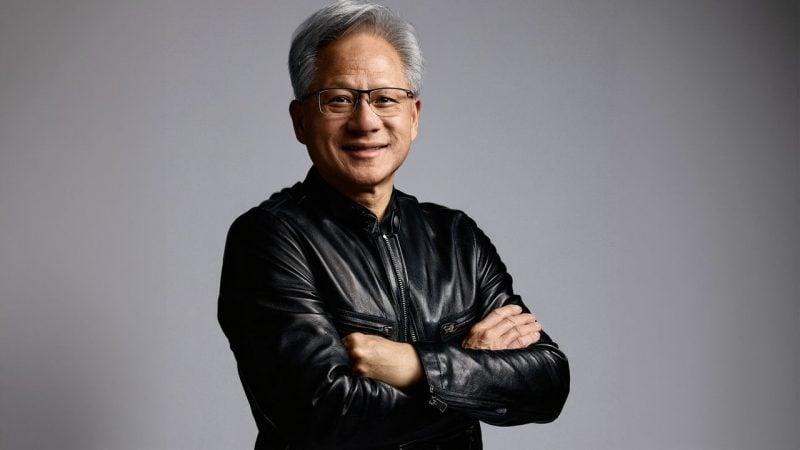
NVIDIA official newsroom (nvidianews.nvidia.com/bios/jensen-huang)
Nvidia lines up Wall Street giants for a $500 billion AI financing push
The chipmaker wants its GPUs treated as collateral, but some investors worry the hardware ages too fast to back long-term loans
Nvidia has spent years selling the picks and shovels of the AI gold rush. Now it wants to help customers pay for them.
The company has launched a plan to raise more than $500 billion in third-party capital to fund AI infrastructure, working alongside six of the biggest names in finance. The pitch is ambitious: treat Nvidia’s chips as collateral, and treat the data centers built around them as an asset class worth investing in.
Six financial heavyweights and a chip-backed pitch
The initiative was announced on August 10-11, 2026. Nvidia’s partners are Apollo Global Management, BlackRock, Blackstone, Brookfield, Goldman Sachs and KKR.
The money is meant to fund data centers and GPU clusters. The target customers include AI labs and cloud service providers, the companies currently burning through capital to build out compute capacity.
The central idea is that Nvidia’s chips can serve as collateral in these deals. Nvidia has packaged this computing infrastructure under its “AI factory” branding. CEO Jensen Huang has argued that the chips are becoming an “investable asset class” capable of generating revenue.
The 25% safety net
To make lenders more comfortable, Nvidia is putting some of its own skin in the game. The company offers a backstop of up to 25% on select deals, capping its support at 25% of residual value.
Residual value is what an asset is expected to be worth at the end of a financing term. By guaranteeing part of that figure, Nvidia is effectively promising lenders that the chips won’t be worthless when the loan comes due.
It is also worth noting the backstop applies only to certain transactions. Not every deal in the pipeline carries Nvidia’s partial guarantee.
AI, tech, and the markets they move—in one daily briefing.
Daily. Free. Join 34,000+ readers across crypto, finance, and policy.
Wall Street’s depreciation problem
As of early October 2026, some Wall Street investors have raised doubts about using Nvidia’s advanced chips as long-term collateral.
Their core concern is depreciation. Cutting-edge AI hardware can lose value quickly as newer generations arrive, and lenders who hold a multi-year loan backed by fast-aging chips could find their collateral shrinking faster than the debt.
As of October 1, 2026, those concerns had translated into demands for stronger guarantees in future financing deals. In other words, some lenders want Nvidia’s 25% cushion to get thicker.
The family connection
One name attached to the effort is Nico Caprez, Jensen Huang’s son-in-law. According to thein.fo, Caprez is helping Nvidia secure financing.
Caprez serves as Nvidia’s Vice President of Global AI Infrastructure Growth. In that role, he focuses on scaling the company’s AI infrastructure partnerships.
Why Nvidia is doing this
For most of the AI boom, Nvidia’s role was straightforward. Customers raised money, then bought chips. Nvidia’s job was to make the chips and ship them.
This initiative changes that dynamic. By helping arrange financing, Nvidia is reaching further down the chain and helping clear one of the biggest obstacles to buying its products: the sheer cost of building AI infrastructure.
If AI labs and cloud providers can more easily fund data centers, they can more easily fill them with Nvidia GPUs.
What this means for investors and the AI buildout
There is an awkward irony in Nvidia’s position. Nvidia’s business depends on releasing faster chips that make older ones less attractive, while this financing model depends on older chips holding their value.
If lenders conclude that GPUs hold their value well enough to back long-dated debt, Nvidia will have created a new financing market around its own products. If not, the company may need to offer stronger guarantees, which would put more risk on its own balance sheet.
Each increase in Nvidia’s backstop makes deals easier to close while tying the company more closely to the long-term value of hardware it has every incentive to make obsolete with its next product cycle.