
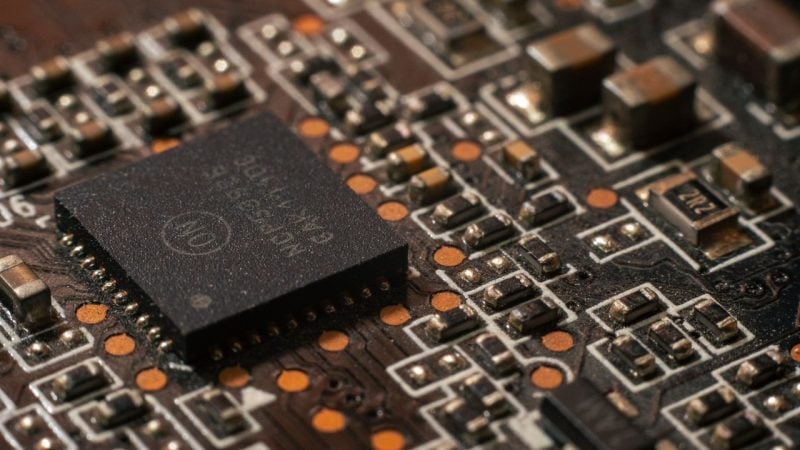
Photo: Ivan Chumak / Pexels
Air Products locks in long-term contract to supply high-purity gases for semiconductor expansion
The industrial gases giant is making its largest-ever bet on the semiconductor sector, with new supply deals spanning South Korea and Taiwan.
Air Products and Chemicals is going all in on chips. The company has secured a long-term contract to supply high-purity industrial gases for Samsung Electronics’ semiconductor fabrication facility in Pyeongtaek, South Korea, marking what the company calls its largest investment commitment to the semiconductor industry to date.
Under the deal, announced in late April, Air Products will construct, own, and operate multiple production facilities along with bulk specialty gas supply infrastructure at the site. Operations are set to phase in between 2028 and 2030.
A sprawling semiconductor bet across Asia
The Pyeongtaek contract is just the opening act. Air Products San Fu, a subsidiary focused on the Asia-Pacific region, landed a separate agreement in July for semiconductor expansion in Taiwan. That deal involves four new air separation units, bulk gas systems, and underground pipelines designed to deliver nitrogen, oxygen, argon, and helium to new fabrication and advanced packaging facilities.
The Taiwan contract is directly tied to surging demand from AI and high-performance computing technologies, which require increasingly sophisticated chip manufacturing processes.
Then in September, Air Products joined a collective $2 billion investment initiative by US companies aimed at strengthening the semiconductor industry in South Korea. The company’s role within that framework centers on expanding gas supply infrastructure in Pyeongtaek, doubling down on a relationship with Samsung that stretches back through multiple prior expansion phases at the site.
AI, tech, and the markets they move—in one daily briefing.
Daily. Free. Join 34,000+ readers across crypto, finance, and policy.
Why industrial gases matter more than ever
The semiconductor supply chain tends to get discussed in terms of lithography machines, silicon wafers, and chip designs. But industrial gases are the invisible backbone of the entire operation. Nitrogen blankets wafers to prevent oxidation. Argon creates inert atmospheres for plasma etching. Specialty gases like silane and phosphine are used in chemical vapor deposition to build the nanoscale layers that make modern chips work.
Industry peers Linde and Air Liquide are both making major investments to support semiconductor growth globally. The industrial gases market for semiconductors has become one of the most reliable growth segments in what is otherwise a cyclical industry.
For Air Products specifically, the Pyeongtaek site is being positioned as its primary global hub for electronics operations.
The domestic question
Air Products’ recent contract announcements have concentrated on international opportunities, specifically Samsung’s Pyeongtaek complex and Taiwan’s expanding fab ecosystem. The company’s participation in the $2 billion US corporate investment pledge for South Korea’s chip sector further underscores its focus on high-growth Asian markets. No new domestic contracts specifically tied to US semiconductor expansion were reported.
For investors watching Air Products (NYSE: APD), the semiconductor pivot represents a long-duration revenue stream. These aren’t one-time equipment sales. They’re build-own-operate agreements where Air Products constructs the infrastructure, retains ownership, and sells gases under multi-year contracts.