
Bank of England expects 1% inflation rise in H2 2026, keeping crypto markets on edge

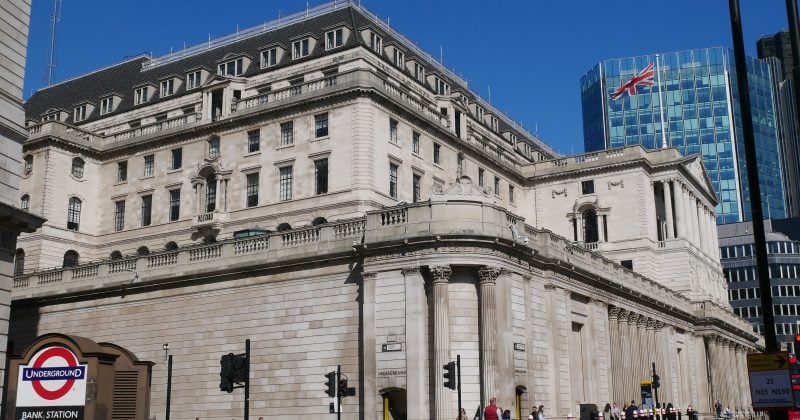
Photo: Doyle of London / Wikimedia Commons / CC BY-SA 4.0 (https://creativecommons.org/licenses/by-sa/4.0)

Bank of England expects 1% inflation rise in H2 2026, keeping crypto markets on edge

Governor Andrew Bailey warns that energy price shocks from the Gulf conflict will push UK inflation well above the 2% target, with interest rates holding steady at 3.75%

The Bank of England just delivered the kind of forecast that makes both traditional investors and crypto traders reach for the antacid. Governor Andrew Bailey is projecting that indirect inflation effects will tack on roughly 0.5 percentage points to UK inflation in the second half of 2026, pushing consumer prices further from the central bank’s 2% target at precisely the wrong moment.

With CPI inflation currently sitting at 2.6% as of June 2026, and projections pointing toward 3.3% by Q3, the UK is staring down a second half of the year where prices accelerate instead of cooling.

Energy prices and geopolitics are doing the heavy lifting

The ongoing conflict related to Iran has sent energy costs on a trajectory that the BoE’s April Monetary Policy Report flagged as a persistent concern. Those costs don’t just show up at the gas pump. They ripple through supply chains, push up production costs, and eventually land in the prices consumers pay for everything from groceries to services.

Advertisement

Bailey put it bluntly: without the Gulf conflict disruptions, the UK would have likely returned to its 2% inflation target around April or May of this year. Instead, the country is watching inflation move in the wrong direction, with energy costs acting as the engine behind the reversal.

Current inflation at 2.6% actually represents a decline from May’s 2.8% reading. Bailey specifically called out these pressures as being “in the pipeline,” meaning the inflation data we’re seeing today doesn’t yet fully reflect the energy cost surge that’s already baked into wholesale markets. By Q4 2026, the BoE expects those effects to push CPI even higher than the Q3 projections.

Interest rates aren’t going anywhere

The BoE is holding its benchmark rate at 3.75%, the lowest level since February 2023. Rates at 3.75% are already low enough that cutting further would risk pouring fuel on inflationary fires, but also high enough to keep pressure on UK borrowing costs, housing markets, and business investment.

The labor market provides some comfort here. Existing slack in employment gives the BoE room to argue that the energy-driven inflation spike won’t spiral into a broader wage-price loop. That distinction matters because wage-driven inflation is the kind central banks truly fear. Energy-driven inflation, while painful, tends to be more transitory.

What this means for crypto and risk assets

When interest rates stay elevated, the opportunity cost of holding non-yielding assets like Bitcoin increases. The BoE’s decision to hold rates steady also signals something broader: major central banks globally are not in a rush to ease monetary policy.

Prolonged higher rates increase financing costs for crypto-adjacent companies, reduce venture capital flows into blockchain startups, and make leverage more expensive for traders using borrowed capital.

Bailey’s inflation warning is one more data point suggesting that pivot isn’t coming from the UK anytime soon. With energy prices remaining elevated due to geopolitical instability and the BoE explicitly warning about pipeline inflation pressures extending through Q4 2026, the macro backdrop for risk assets remains complicated at best.

Disclosure: This article was edited by Editorial Team. For more information on how we create and review content, see our Editorial Policy.

Bank of England expects 1% inflation rise in H2 2026, keeping crypto markets on edge

Bank of England expects 1% inflation rise in H2 2026, keeping crypto markets on edge

Governor Andrew Bailey warns that energy price shocks from the Gulf conflict will push UK inflation well above the 2% target, with interest rates holding steady at 3.75%

Photo: Doyle of London / Wikimedia Commons / CC BY-SA 4.0 (https://creativecommons.org/licenses/by-sa/4.0)

The Bank of England just delivered the kind of forecast that makes both traditional investors and crypto traders reach for the antacid. Governor Andrew Bailey is projecting that indirect inflation effects will tack on roughly 0.5 percentage points to UK inflation in the second half of 2026, pushing consumer prices further from the central bank’s 2% target at precisely the wrong moment.

With CPI inflation currently sitting at 2.6% as of June 2026, and projections pointing toward 3.3% by Q3, the UK is staring down a second half of the year where prices accelerate instead of cooling.

Energy prices and geopolitics are doing the heavy lifting

The ongoing conflict related to Iran has sent energy costs on a trajectory that the BoE’s April Monetary Policy Report flagged as a persistent concern. Those costs don’t just show up at the gas pump. They ripple through supply chains, push up production costs, and eventually land in the prices consumers pay for everything from groceries to services.

Advertisement

Bailey put it bluntly: without the Gulf conflict disruptions, the UK would have likely returned to its 2% inflation target around April or May of this year. Instead, the country is watching inflation move in the wrong direction, with energy costs acting as the engine behind the reversal.

Current inflation at 2.6% actually represents a decline from May’s 2.8% reading. Bailey specifically called out these pressures as being “in the pipeline,” meaning the inflation data we’re seeing today doesn’t yet fully reflect the energy cost surge that’s already baked into wholesale markets. By Q4 2026, the BoE expects those effects to push CPI even higher than the Q3 projections.

Interest rates aren’t going anywhere

The BoE is holding its benchmark rate at 3.75%, the lowest level since February 2023. Rates at 3.75% are already low enough that cutting further would risk pouring fuel on inflationary fires, but also high enough to keep pressure on UK borrowing costs, housing markets, and business investment.

The labor market provides some comfort here. Existing slack in employment gives the BoE room to argue that the energy-driven inflation spike won’t spiral into a broader wage-price loop. That distinction matters because wage-driven inflation is the kind central banks truly fear. Energy-driven inflation, while painful, tends to be more transitory.

What this means for crypto and risk assets

When interest rates stay elevated, the opportunity cost of holding non-yielding assets like Bitcoin increases. The BoE’s decision to hold rates steady also signals something broader: major central banks globally are not in a rush to ease monetary policy.

Prolonged higher rates increase financing costs for crypto-adjacent companies, reduce venture capital flows into blockchain startups, and make leverage more expensive for traders using borrowed capital.

Bailey’s inflation warning is one more data point suggesting that pivot isn’t coming from the UK anytime soon. With energy prices remaining elevated due to geopolitical instability and the BoE explicitly warning about pipeline inflation pressures extending through Q4 2026, the macro backdrop for risk assets remains complicated at best.

Disclosure: This article was edited by Editorial Team. For more information on how we create and review content, see our Editorial Policy.