
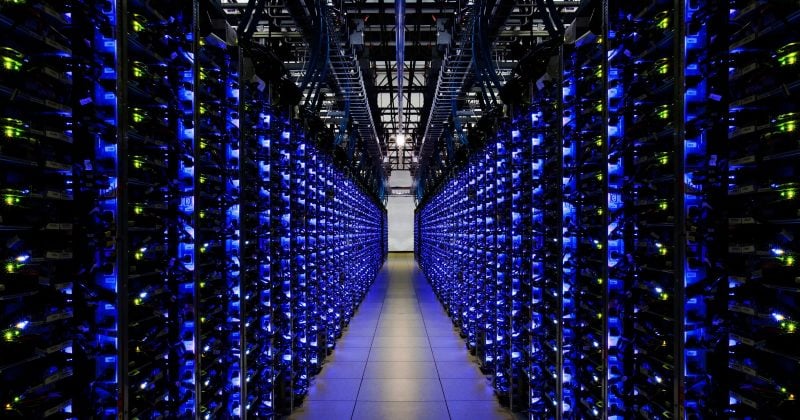
Via datacenters.google
Data center costs surge past $170B in a single quarter as Big Tech’s AI arms race heats up
Amazon, Google, Meta, and Microsoft are collectively on track to spend $1.5 trillion on data center and chip infrastructure by end of 2027, reshaping capital markets in the process.
The four largest cloud and AI companies just spent $170 billion on data centers in a single quarter. That’s up 72% from the same period last year.
Amazon, Alphabet (Google’s parent), Meta, and Microsoft are in the middle of an infrastructure spending spree. Wall Street estimates now peg their combined capital expenditure at roughly $1.5 trillion through the end of 2027.
The numbers behind the buildout
Amazon led the charge in Q2 2026 with $53 billion in capex, a 69% jump year-over-year. The company also raised its full-year guidance to approximately $220 billion, citing soaring memory chip costs as a key driver.
Meta reported a 55% year-on-year increase in its infrastructure costs, pushing it to revise its 2026 capex target upward to $130 billion.
Component price inflation alone added tens of billions to hyperscaler budgets during the quarter. In Q1 2025, industry capex was already up 53% year-over-year to $134 billion.
All four companies have pledged investments in new power generation capacity to keep their servers running.
AI, tech, and the markets they move—in one daily briefing.
Daily. Free. Join 34,000+ readers across crypto, finance, and policy.
Why crypto investors should be paying attention
Nvidia, AMD, and other semiconductor firms are allocating massive portions of their output to hyperscaler contracts. That same supply chain feeds into crypto mining hardware and blockchain infrastructure. Bitcoin miners, particularly publicly traded ones like Marathon Digital and Riot Platforms, have already been navigating a tighter hardware market.
Companies like Core Scientific and Hut 8 have struck deals to repurpose mining facilities for AI workloads. When Big Tech starts competing for power generation capacity, signing long-term energy contracts, and even building their own power plants, it reshapes the energy landscape for everyone.
When four companies are collectively spending at a $680 billion annual run rate on infrastructure, that capital either comes from operating cash flow or from debt markets, where it competes with every other borrower for capital.
What this means for investors
The bull case: these companies are building the infrastructure layer for the next decade of AI applications.
The bear case: spending $1.5 trillion over a few years only works if the revenue materializes at sufficient margins. If it doesn’t, you’ve got the most expensive stranded assets in corporate history.
Every megawatt of new generation capacity that Big Tech finances today becomes part of a broader grid. The relationship between AI data centers and Bitcoin mining facilities is increasingly symbiotic, with shared power infrastructure and even shared physical locations.