
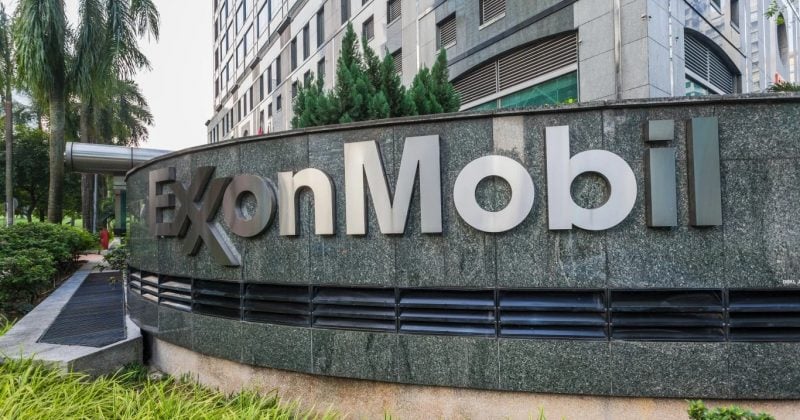
Via 247wallst.com
Exxon CEO expects Strait of Hormuz to reopen, but warns oil flows need months to recover
Darren Woods says normalization could take one to two months even after the chokepoint reopens, keeping energy markets on edge
The world’s most important oil chokepoint has been closed since early April, and the CEO of one of the world’s largest energy companies says don’t expect things to snap back to normal overnight.
ExxonMobil’s Darren Woods, speaking on the company’s Q1 2026 earnings call on May 1, said the Strait of Hormuz would likely reopen but that oil flows would need a month or two to fully normalize after that happens.
Why the Strait of Hormuz is the oil market’s single point of failure
Think of the Strait of Hormuz as the world’s most critical energy corridor, roughly 21 miles wide at its narrowest point, connecting the Persian Gulf to the rest of the global oil market.
Nearly 20% of global oil and LNG trade passes through it.
The strait has been effectively shut since early April following the escalation of conflict involving Iran, and the market has felt it. Oil prices on May 1 were swinging between $101 and $108 per barrel. Woods noted on the call that the market had not yet fully priced in the scale of the disruption.
Even after a shipping lane reopens, tankers need to be repositioned, insurance underwriters need to reassess risk ratings, and buyers need to rebuild confidence in route reliability.
The U.S.-Iran deal and what it means for prices
A U.S.-Iran memorandum of understanding was announced in mid-June 2026, aimed at reopening the strait and extending a ceasefire by 60 days, with the deal ratified around June 17.
The news moving money, markets, and the world—before your day starts.
Daily. Free. Join 34,000+ readers across crypto, finance, and policy.
Markets responded the way you’d expect: oil prices pulled back on the news, and energy stocks, including Exxon, took a hit.
For Exxon specifically, higher oil prices generally translate to stronger earnings. A de-escalation that brings prices down meaningfully compresses that upside, even if the underlying business remains healthy.
The 60-day ceasefire extension introduces a ticking clock. If the deal holds, markets get a window of relative calm. If it fractures, the disruption narrative returns quickly.
What energy investors should be watching now
The immediate question for traders and portfolio managers isn’t whether the strait reopens. It’s how durable the reopening proves to be, and whether the one-to-two month normalization timeline Woods described plays out as projected or stretches longer.
Longer shipping route diversions, where tankers sail around the Cape of Good Hope rather than through the strait, add roughly two weeks of transit time. That’s a sustained drag on LNG delivery schedules, particularly for Asian buyers who rely heavily on Persian Gulf supply.
The LNG angle matters here in a way that often gets underreported. The Strait of Hormuz isn’t just an oil corridor. It’s a critical pathway for liquefied natural gas, and the European and Asian markets that spent the last several years scrambling to diversify away from Russian gas are now contending with a second major supply route under stress.
What Woods said on May 1 amounted to responsible expectation management: the strait will likely reopen, the timing is unclear, and even when it does, assume disruption for another month or two.
The U.S.-Iran memorandum is a step, not a solution. Sixty-day ceasefires in the Middle East have a history of requiring renewal, renegotiation, or simply collapsing.