
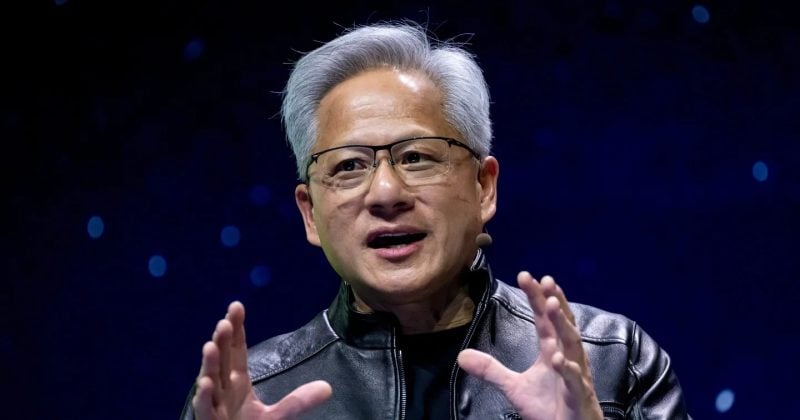
Nvidia CEO Jensen Huang warns AI bubble unlikely in next five years

Nvidia CEO Jensen Huang warns AI bubble unlikely in next five years

Huang points to massive infrastructure gaps and hardware constraints as reasons the AI boom has plenty of runway left

Jensen Huang wants you to know that the AI party isn’t ending anytime soon. The Nvidia CEO told attendees at the World Economic Forum in Davos that while an AI bubble will “arrive someday,” physical constraints on infrastructure and hardware make a near-term collapse unlikely within the next five years.

The trillion-dollar gap

At Davos, Huang emphasized that AI requires “trillions of dollars” more in infrastructure investment just to keep pace with current demand trajectories. The world doesn’t have nearly enough data centers, chips, and networking equipment to support what companies are trying to build.

Advertisement

Goldman Sachs projects AI capital expenditures to reach approximately $765 billion in 2026 alone. That’s a staggering number, roughly equivalent to the entire GDP of the Netherlands, and it still might not be enough to satisfy the appetite for compute.

Nvidia’s Q4 2025 earnings, reported on November 19, 2025, showed sold-out cloud GPU inventory and record demand for its next-generation chips.

Why crypto investors should pay attention

Huang’s remarks didn’t mention any specific cryptocurrencies or blockchain projects. During the last crypto bull run, GPU demand was heavily driven by miners. Now that demand engine has been almost entirely replaced by AI workloads.

Reading between the lines

Nvidia’s earnings in November showed sold-out cloud GPUs. The Goldman Sachs projection of $765 billion in 2026 AI capex represents the combined spending plans of hyperscalers like Microsoft, Google, Amazon, and Meta.

The dot-com bubble didn’t pop because demand for the internet was fake. It popped because valuations got disconnected from the timeline required to build out infrastructure and develop business models. Huang’s argument is essentially that AI hasn’t reached that disconnect yet because the infrastructure itself is still desperately undersupplied.

Disclosure: This article was edited by Editorial Team. For more information on how we create and review content, see our Editorial Policy.

Nvidia CEO Jensen Huang warns AI bubble unlikely in next five years

Nvidia CEO Jensen Huang warns AI bubble unlikely in next five years

Huang points to massive infrastructure gaps and hardware constraints as reasons the AI boom has plenty of runway left

Jensen Huang wants you to know that the AI party isn’t ending anytime soon. The Nvidia CEO told attendees at the World Economic Forum in Davos that while an AI bubble will “arrive someday,” physical constraints on infrastructure and hardware make a near-term collapse unlikely within the next five years.

The trillion-dollar gap

At Davos, Huang emphasized that AI requires “trillions of dollars” more in infrastructure investment just to keep pace with current demand trajectories. The world doesn’t have nearly enough data centers, chips, and networking equipment to support what companies are trying to build.

Advertisement

Goldman Sachs projects AI capital expenditures to reach approximately $765 billion in 2026 alone. That’s a staggering number, roughly equivalent to the entire GDP of the Netherlands, and it still might not be enough to satisfy the appetite for compute.

Nvidia’s Q4 2025 earnings, reported on November 19, 2025, showed sold-out cloud GPU inventory and record demand for its next-generation chips.

Why crypto investors should pay attention

Huang’s remarks didn’t mention any specific cryptocurrencies or blockchain projects. During the last crypto bull run, GPU demand was heavily driven by miners. Now that demand engine has been almost entirely replaced by AI workloads.

Reading between the lines

Nvidia’s earnings in November showed sold-out cloud GPUs. The Goldman Sachs projection of $765 billion in 2026 AI capex represents the combined spending plans of hyperscalers like Microsoft, Google, Amazon, and Meta.

The dot-com bubble didn’t pop because demand for the internet was fake. It popped because valuations got disconnected from the timeline required to build out infrastructure and develop business models. Huang’s argument is essentially that AI hasn’t reached that disconnect yet because the infrastructure itself is still desperately undersupplied.

Disclosure: This article was edited by Editorial Team. For more information on how we create and review content, see our Editorial Policy.