
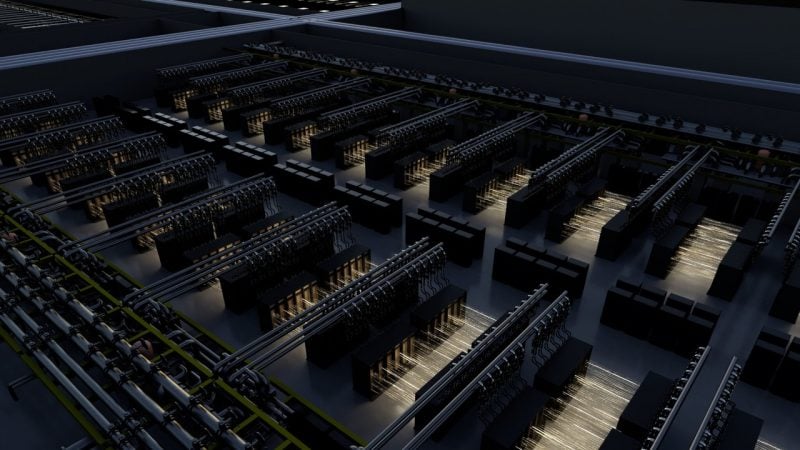
Toshiba plans $380M investment to double AI data center HDD capacity by FY2027

Toshiba plans $380M investment to double AI data center HDD capacity by FY2027

The Japanese giant is betting roughly 60 billion yen that spinning disks still have a big role to play in the AI storage boom

Toshiba is putting approximately 60 billion yen, or about $380 million, into expanding its hard disk drive manufacturing in the Philippines. The goal is to double production capacity for drives aimed at AI data centers by fiscal year 2027, which ends in March 2028.

The move marks Toshiba’s first major HDD investment in five years. It also comes with a long-range roadmap: mass production of 65TB-class drives by 2030, with models above 100TB planned after that.

What Toshiba is actually building

The expansion centers on Toshiba’s facility in the Philippines. New production lines there are designed to turn out drives with up to 40% more storage capacity per unit.

Automation is the other major piece of the plan. Toshiba is upgrading inspection and cleanroom processes, and the company expects the changes to cut workforce needs by around 40%.

On the technology side, Toshiba is leaning on two techniques to push capacity higher. The first is Microwave-Assisted Magnetic Recording, or MAMR, and the second is 12-disk stacking.

Advertisement

Think of MAMR as giving the drive’s write head a small energy boost. A burst of microwave energy helps it record data onto smaller, more tightly packed magnetic regions. Smaller regions mean more data squeezed onto each platter.

Stacking 12 disks inside a standard drive enclosure works on a simpler principle. More platters in the same box equals more total storage, provided the engineering holds up.

Combined, these approaches underpin Toshiba’s path from today’s drives to the 65TB-class target and, eventually, the 100TB-class tier.

Why AI needs old-school storage

Modern data centers typically handle this with a tiered approach. High-performance solid-state drives handle the fast, frequently accessed work, while high-density HDDs store the bulk data that does not need instant retrieval.

The economics explain the split. HDDs are about 20 times cheaper per terabyte than SSDs.

The three-horse race gets more competitive

The global HDD market is dominated by three players: Western Digital, Seagate, and Toshiba.

Toshiba is not content with its current position. The company wants to lift its market share, measured by storage capacity, from slightly above 10% to 30% over the coming years.

What to watch from here

The first milestone is execution in the Philippines. Doubling production capacity by the end of fiscal 2027 requires new lines, new automation, and new processes to come online without major hiccups.

The technology roadmap is the longer game. Mass production of 65TB-class drives by 2030 depends on MAMR and 12-disk stacking scaling reliably, and the 100TB-class models beyond that remain a stated ambition rather than a scheduled product.

The market share target is the clearest scorecard. Moving from slightly above 10% to 30% would reshape the competitive balance among the big three.

Disclosure: This article was edited by Diego Almada Lopez. For more information on how we create and review content, see our Editorial Policy.
Toshiba plans $380M investment to double AI data center HDD capacity by FY2027

The Japanese giant is betting roughly 60 billion yen that spinning disks still have a big role to play in the AI storage boom

Toshiba is putting approximately 60 billion yen, or about $380 million, into expanding its hard disk drive manufacturing in the Philippines. The goal is to double production capacity for drives aimed at AI data centers by fiscal year 2027, which ends in March 2028.

The move marks Toshiba’s first major HDD investment in five years. It also comes with a long-range roadmap: mass production of 65TB-class drives by 2030, with models above 100TB planned after that.

What Toshiba is actually building

The expansion centers on Toshiba’s facility in the Philippines. New production lines there are designed to turn out drives with up to 40% more storage capacity per unit.

Automation is the other major piece of the plan. Toshiba is upgrading inspection and cleanroom processes, and the company expects the changes to cut workforce needs by around 40%.

On the technology side, Toshiba is leaning on two techniques to push capacity higher. The first is Microwave-Assisted Magnetic Recording, or MAMR, and the second is 12-disk stacking.

Advertisement

Think of MAMR as giving the drive’s write head a small energy boost. A burst of microwave energy helps it record data onto smaller, more tightly packed magnetic regions. Smaller regions mean more data squeezed onto each platter.

Stacking 12 disks inside a standard drive enclosure works on a simpler principle. More platters in the same box equals more total storage, provided the engineering holds up.

Combined, these approaches underpin Toshiba’s path from today’s drives to the 65TB-class target and, eventually, the 100TB-class tier.

Why AI needs old-school storage

Modern data centers typically handle this with a tiered approach. High-performance solid-state drives handle the fast, frequently accessed work, while high-density HDDs store the bulk data that does not need instant retrieval.

The economics explain the split. HDDs are about 20 times cheaper per terabyte than SSDs.

The three-horse race gets more competitive

The global HDD market is dominated by three players: Western Digital, Seagate, and Toshiba.

Toshiba is not content with its current position. The company wants to lift its market share, measured by storage capacity, from slightly above 10% to 30% over the coming years.

What to watch from here

The first milestone is execution in the Philippines. Doubling production capacity by the end of fiscal 2027 requires new lines, new automation, and new processes to come online without major hiccups.

The technology roadmap is the longer game. Mass production of 65TB-class drives by 2030 depends on MAMR and 12-disk stacking scaling reliably, and the 100TB-class models beyond that remain a stated ambition rather than a scheduled product.

The market share target is the clearest scorecard. Moving from slightly above 10% to 30% would reshape the competitive balance among the big three.

Disclosure: This article was edited by Diego Almada Lopez. For more information on how we create and review content, see our Editorial Policy.