
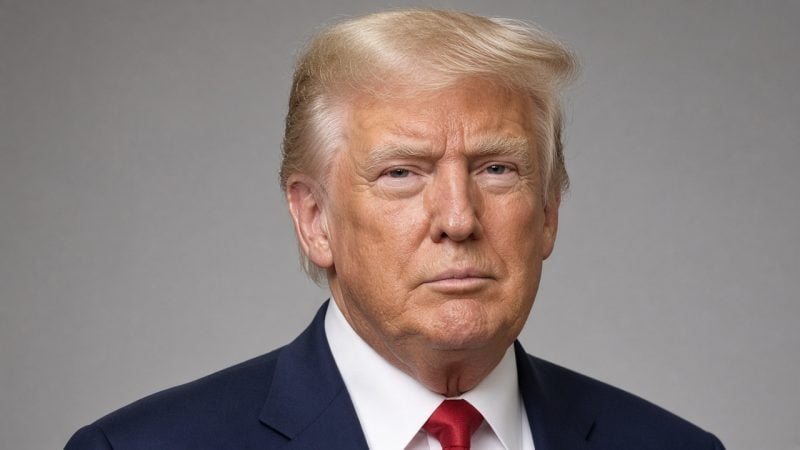
Trump says US AI companies cannot slow down if America wants to beat China
The president is framing AI as a national security race, even as one benchmark gap between US and Chinese models appears to be shrinking
President Donald Trump has a message for America’s AI companies: keep going.
Trump says US AI developers cannot afford to slow down because the country needs to outperform China. That puts the White House squarely on the side of speed in a debate where some of the industry’s own leaders have been asking for caution.
Accelerate first, ask questions later
In September 2026, Trump argued that the US must speed up its AI development to keep its edge over China. He described AI supremacy as essential to both national security and economic strength.
He made the case on Truth Social and at a summit with Chinese President Xi Jinping. In doing so, he waved off warnings from prominent AI executives about the risks of racing ahead without regulatory guardrails.
Trump went further than dismissing those concerns. He characterized them as a “hoax” that benefits China, recasting AI safety as a geopolitical liability rather than a technical one.
Trump also outlined plans for an “AI Force,” modeled on the Space Force, along with the appointment of an “AI Czar.”
The gap is shrinking, at least on one measure
Bloomberg Intelligence reported that as of early October 2026, the performance gap between leading US AI systems and top Chinese models had narrowed to roughly 3%.
AI, tech, and the markets they move—in one daily briefing.
Daily. Free. Join 34,000+ readers across crypto, finance, and policy.
That figure was 9% back in May. Within a single season, two-thirds of the measured lead disappeared.
Chinese models such as DeepSeek V4.1 now trail US systems by only approximately 3%, per that reporting.
The US continues to dominate the hardware layer of AI: advanced chips and raw computing power. America holds about 75% of global top AI supercomputer capacity, while China has around 15%.
A summit with a hotline and not much else
The late September meeting between Trump and Xi produced limited cooperation. The two sides set up a communication channel for AI incidents, essentially a hotline for when something goes wrong.
They also planned a dialogue for November. There was no agreement on joint AI development, and joint ventures in the field were ruled out. Nor was there any deal to slow the pace of advancement on either side.
What this means for the AI industry and investors
For AI companies, the signal from Washington is clear. The federal government is prioritizing speed and treating regulation skeptically, at least for now.
That could draw more investment toward US-based AI firms, particularly those central to semiconductor production and supply. Nvidia, whose chips underpin much of today’s AI buildout, is an obvious example of a company whose fortunes are tied to the compute side of this contest.
The narrowing model gap is the number worth tracking. If Chinese labs keep closing in despite trailing badly on compute, it raises questions about how durable the US hardware advantage really is as a moat.
If the US lead in supercomputing holds near 75%, American labs may still have the capacity to pull ahead again.