
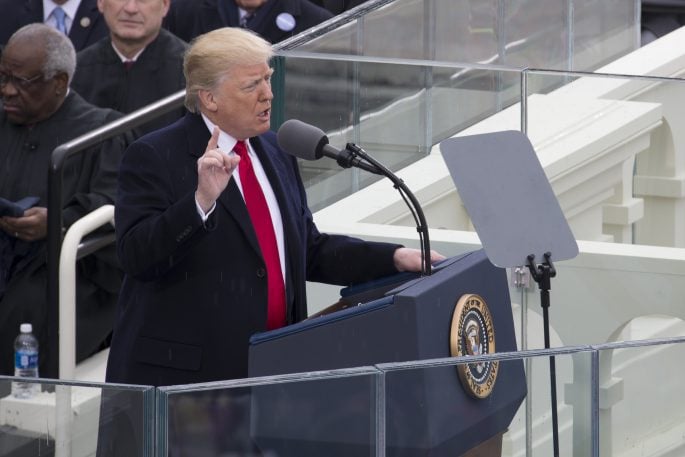
U.S. Marine Corps Lance Cpl. Cristian L. Ricardo
Trump rules out US-China AI joint venture, citing security concerns
The president rejected calls for collaborative AI development with Beijing, insisting the US lead is too valuable to share
President Donald Trump shut the door on any joint AI development with China at a summit on September 26, declaring that the US technological advantage is simply too large to risk diluting.
“I would rather not integrate because we’re leading by a lot,” Trump said. He estimated the US holds at least a one-year lead in AI capabilities over China, with some assessments putting the gap closer to two years.
What actually came out of the summit
The meeting wasn’t a total shutout. The two countries agreed to establish a “U.S.-China Super Intelligence (SI) Dialogue” before November 2026, a forum designed to discuss the risks and benefits of advanced AI systems. They also set up a bilateral communication channel specifically for handling AI and superintelligence-related incidents.
Trump reportedly pushed to use the term “super intelligence” in official contexts. What the summit did not produce is arguably more telling than what it did. There were no agreements on cooperative AI development. No joint regulatory frameworks. No pathways toward technology sharing of any kind. The communication channel is narrow by design, limited to incident response rather than strategic coordination.
“When you’re leading, you don’t open it up to each other,” Trump stated.
AI, tech, and the markets they move—in one daily briefing.
Daily. Free. Join 34,000+ readers across crypto, finance, and policy.
The bigger picture on US-China tech rivalry
The US has spent years tightening restrictions on semiconductor exports to China, targeting the foundational hardware that powers AI training and deployment. Beijing, meanwhile, has faced persistent allegations that Chinese AI firms have copied or reverse-engineered American models to close the capability gap.
Trump’s stance puts him at odds with a notable contingent of tech industry executives and international organizations that have argued for regulatory collaboration on AI. Their logic: superintelligent systems pose existential risks that don’t respect national borders, and managing those risks requires shared governance. The counterargument, which the administration clearly favors, is that collaboration gives adversaries a shortcut to capabilities they haven’t earned independently.
What this means for the tech sector and beyond
For the semiconductor industry, which sits at the foundation of every AI system, the summit reinforces the existing trajectory of export controls and supply chain decoupling.
The creation of the SI Dialogue does leave one small window open. If an AI-related incident creates genuine shared risk, the communication infrastructure exists to manage it.
The one-to-two-year lead Trump cited is meaningful in AI terms, but it’s not an insurmountable moat. Traders and investors should keep a close eye on how the SI Dialogue actually functions once it launches before November 2026.