
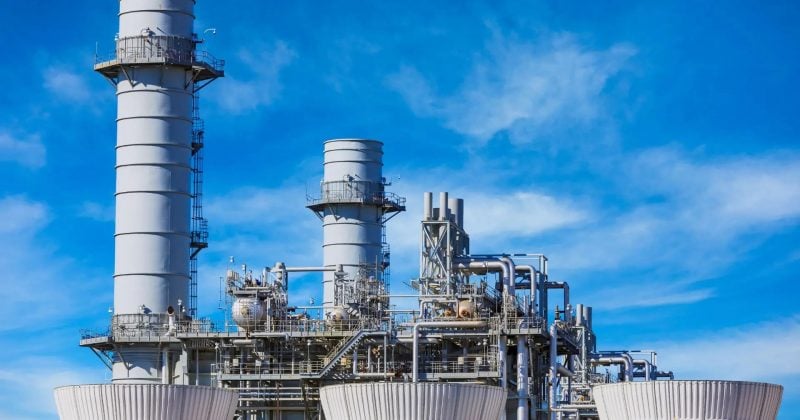
Via interestingengineering.com
Chevron and Williams bet billions on gas-fired power plants to feed AI’s insatiable energy appetite
Big oil's pivot to direct power generation for data centers could reshape energy markets and the infrastructure underpinning crypto mining and AI compute.
The AI boom has an energy problem, and two of America’s biggest fossil fuel companies think they have the answer. Chevron and Williams are pouring billions into building natural gas power plants designed to sit right next to data centers, bypassing the traditional electrical grid entirely.
Chevron locked in a 20-year power purchase agreement with Microsoft for a project in West Texas that will deliver roughly 2.5 to 2.67 GW of electricity, with the potential to scale up to 5 GW. Williams, meanwhile, has committed over $5 billion to what it calls its “Power Innovation” portfolio, a collection of modular gas-fired plants aimed squarely at the hyperscale compute market.
Behind the meter, ahead of the curve
Chevron’s West Texas complex in the Permian Basin is expected to begin operations in 2027. The company formed a partnership back in January 2025 with Engine No. 1 and GE Vernova, targeting up to 4 GW of total capacity spread across multiple US sites. The Microsoft deal, announced on June 22, 2026, is the crown jewel of that effort.
Williams is taking a slightly different approach, building project-specific facilities for individual tech clients. Project Socrates will deliver 400 MW to a Meta-affiliated campus by late 2026. A larger project called NEO is on track to produce 682 MW by 2028.
Why crypto should be paying attention
Crypto miners and AI data centers are increasingly competing for the same scarce resource: cheap, reliable electricity. Bitcoin mining operations have historically thrived in areas with surplus energy, particularly in Texas, where the deregulated grid and proximity to natural gas production created ideal conditions. The Permian Basin, where Chevron is building its massive new complex, is one of those areas.
The news moving money, markets, and the world—before your day starts.
Daily. Free. Join 34,000+ readers across crypto, finance, and policy.
As Big Oil pivots toward long-term power purchase agreements with deep-pocketed tech giants like Microsoft and Meta, these 20-year deals effectively lock up energy supply for decades. Microsoft can commit to a two-decade contract at premium rates. Most Bitcoin mining operations can’t, or won’t, make that kind of commitment given the cyclical nature of mining economics.
Some mining companies have started pivoting toward AI compute themselves, recognizing that hosting AI workloads can be more profitable per megawatt than mining Bitcoin. Companies like Core Scientific and Hut 8 have already begun converting portions of their infrastructure to serve AI clients.
What this means for investors
Natural gas producers with long-term PPAs in place are essentially locking in stable revenue streams for decades, which is a very different risk profile than the boom-and-bust cycles that have historically defined fossil fuel companies.
The infrastructure buildout itself creates opportunity. Companies that manufacture gas turbines, build pipelines, or provide grid interconnection services stand to benefit from the billions being deployed. GE Vernova’s involvement in Chevron’s partnership is a direct example.