
China’s homegrown chip machines rattle markets, ETH holds its ground
A state-backed Shanghai company broke ASML's lithography monopoly, sending shockwaves through AI stocks and crypto, but Ethereum quietly outperformed for a full month running.
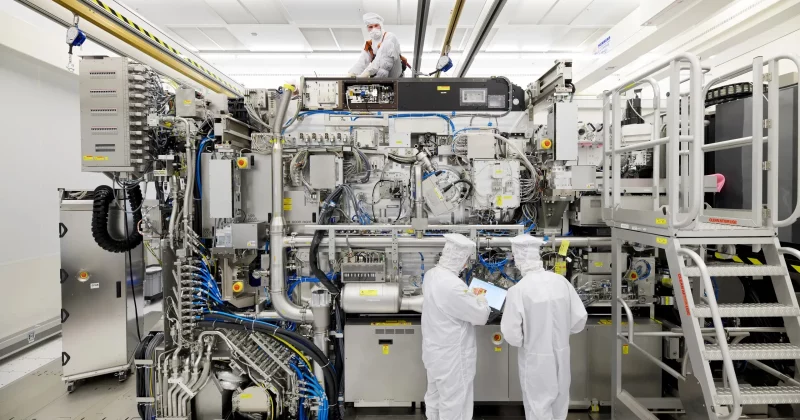
A state-backed company in Shanghai started producing lithography machines that were previously the exclusive domain of Dutch giant ASML. That single development managed to spook AI stocks, drag the S&P 500 lower, and send ripples through crypto on Monday.
But here’s the thing: not everything went down equally. Ethereum has been quietly flexing relative strength, with the ETH/BTC ratio outperforming for a full month now. In a market defined by fear, that kind of consistency is worth paying attention to.
What happened and why markets flinched
Lithography machines are the beating heart of advanced semiconductor manufacturing. They’re the tools that etch nanoscale circuits onto silicon wafers, and for years, ASML has held what amounted to a global monopoly on the most sophisticated versions. Think of it like being the only company that makes the printer for every country’s currency. If someone else suddenly builds their own printer, that changes the entire power dynamic.
China doing exactly that sent a clear message to markets: the US-led chip containment strategy has limits. If Chinese firms can produce competitive lithography equipment domestically, the entire thesis behind AI hardware scarcity, and the premium valuations attached to it, starts to wobble.
AI and semiconductor stocks took the hit first. The selling pressure then bled into broader indices, pulling down the S&P 500. And because crypto has increasingly traded as a risk-correlated asset class, Bitcoin and friends got caught in the downdraft too.
Bitcoin slipped below $64,600. Solana climbed above $75, bucking the trend slightly with a 0.7% gain over 24 hours. XRP dipped below $1.10. None of these moves were catastrophic, but the direction told a story: macro fear was in the driver’s seat.
The Fear and Greed Index sat at 30 on Monday, firmly in “Fear” territory. Last week it was 29. So sentiment hasn’t really improved. It just hasn’t gotten worse either, which in this environment counts as a small win.
The news moving money, markets, and the world—before your day starts.
Daily. Free. Join 34,000+ readers across crypto, finance, and policy.
Ethereum’s quiet month of outperformance
While Bitcoin grabbed most of the attention for its price swings, Ethereum posted a 2.3% gain over 24 hours, the strongest move among major tokens on the day. That’s not a one-off data point. The ETH/BTC ratio has been trending higher for a full month now, suggesting that capital within the crypto ecosystem is rotating toward Ethereum.
Look, ETH outperforming BTC during periods of macro stress isn’t the historical norm. Bitcoin typically plays the role of relative safe haven within crypto, the asset people flee to when things get shaky. When ETH gains ground against BTC during a fearful market, it usually signals something structural is shifting underneath.
Part of that shift could be tied to the broader DeFi narrative. DeFi was the top-performing category over the past seven days, according to CoinGecko data, though gains were essentially flat at 0.0%. In English: DeFi didn’t go up, but it also didn’t go down while everything else was bleeding. That relative resilience tends to benefit Ethereum, which remains the foundational layer for most DeFi activity.
Bitcoin’s own numbers tell a more muted story. A 0.2% gain over 24 hours and 0.5% over seven days. Those are the kind of returns that make you check if your screen refreshed. BTC is treading water while ETH is paddling forward, even if slowly.
The bigger picture: chips, tariffs, and risk appetite
This lithography news doesn’t exist in a vacuum. It lands in a market already on edge about US-China tensions, semiconductor export controls, and the sustainability of AI valuations that have powered equity markets for over a year. If China can produce its own advanced chip-making equipment, the leverage that US export restrictions provided starts to erode.
For crypto investors, the transmission mechanism is straightforward. Anything that hits risk appetite in traditional markets tends to suppress crypto flows, especially into Bitcoin and larger-cap tokens. The correlation between BTC and the Nasdaq has been stubbornly high throughout 2024 and into 2025, meaning chip stock selloffs aren’t just a Wall Street problem.
The more interesting question is whether Ethereum’s relative strength can persist if macro conditions deteriorate further. ETH holding near $1,930 while BTC slides suggests there’s genuine demand, not just correlated drift. But a month of outperformance doesn’t make a trend, and the Fear and Greed Index hovering at 30 means the broader market hasn’t found its footing yet.
What investors should watch is whether the ETH/BTC ratio holds its gains through the next macro shock. If it does, that would mark a meaningful shift in how capital is allocated within crypto during risk-off periods. If it doesn’t, this month becomes a footnote. Either way, the fact that a Chinese lithography machine is now a variable in your crypto portfolio tells you everything about how interconnected these markets have become.