
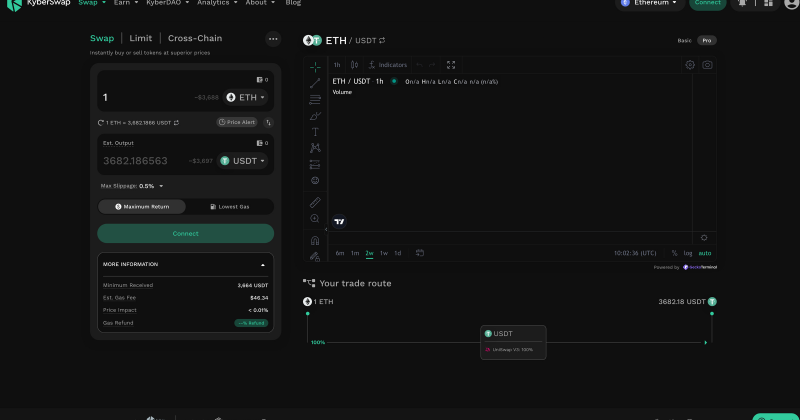
DeFi aggregators shift to intent-based trading as KyberSwap takes commanding lead

Via kyberswap.webflow.io

DeFi aggregators shift to intent-based trading as KyberSwap takes commanding lead

The new trading model lets solvers compete to fill user orders off-chain, and one aggregator is pulling away from the pack with 31% market share.

The way DeFi aggregators route your trades is undergoing a fundamental rewiring. Instead of constructing rigid on-chain transaction paths, the leading platforms are shifting to intent-based architectures, where users simply declare what they want, and a network of competing solvers figures out the best way to deliver it.

How intent-based trading actually works

In the traditional aggregator model, a user’s swap gets broken into a predetermined route across various liquidity pools, all executed on-chain. Every step is scripted before the transaction fires. Intent-based trading flips this on its head.

Users sign off-chain messages expressing their desired outcome. Something like: “swap 10 ETH for at least 25,000 USDC, with MEV protection, across any chain.” Solvers, sometimes called resolvers, then compete to fulfill that intent as efficiently as possible.

This competition among solvers tends to produce better execution prices, since each one is incentivized to find the most efficient path across fragmented liquidity. It also unlocks gasless execution for users, since the solver fronts the gas and bakes the cost into the trade. MEV protection comes almost as a side effect, because the orders never sit in a public mempool waiting to be sandwiched.

Advertisement

KyberSwap pulls ahead in a shrinking market

Here’s the thing about KyberSwap’s dominance: it’s happening while the overall pie is getting smaller. Aggregator trading volumes have declined approximately 40% in early 2026, a pullback that mirrors broader crypto market conditions and reduced speculative activity.

Despite that headwind, KyberSwap has captured around 31% of DEX aggregator market share. CoW Swap trails at roughly 22%, with 1inch holding about 15%. The remaining third is scattered among a long tail of smaller players.

KyberSwap’s edge comes down to infrastructure breadth. The platform aggregates liquidity from more than 420 sources across 17 different chains, giving it an unusually wide net for finding optimal trade execution. Over its lifetime, KyberSwap has facilitated more than $150 billion in transactions.

CoW Swap, for its part, pioneered much of the intent-based approach with its batch auction model, where orders are collected and settled together to find coincidences of wants. It remains a strong competitor, particularly on Ethereum mainnet, but its narrower chain coverage limits its ability to match KyberSwap’s cross-chain reach.

1inch has been pushing its own intent-based product through 1inch Fusion, which uses a Dutch auction mechanism to let resolvers compete for order fills. UniswapX, Uniswap’s own intent layer, is also in the mix but still gaining traction relative to the incumbents.

Why the aggregator wars matter for DeFi investors

For liquidity providers, KyberSwap has introduced conditional smart exits, a feature that lets liquidity providers set automated conditions for withdrawing their positions.

The cross-chain dimension is where things get particularly interesting for sophisticated traders. Intent-based systems can handle multi-chain swaps as a single atomic action, with solvers fronting liquidity on the destination chain before settlement completes on the source chain.

The risk worth watching is solver centralization. If too few solvers dominate order flow, the competitive dynamics that make intent-based trading attractive could erode.

Disclosure: This article was edited by Editorial Team. For more information on how we create and review content, see our Editorial Policy.

DeFi aggregators shift to intent-based trading as KyberSwap takes commanding lead

DeFi aggregators shift to intent-based trading as KyberSwap takes commanding lead

The new trading model lets solvers compete to fill user orders off-chain, and one aggregator is pulling away from the pack with 31% market share.

Via kyberswap.webflow.io

The way DeFi aggregators route your trades is undergoing a fundamental rewiring. Instead of constructing rigid on-chain transaction paths, the leading platforms are shifting to intent-based architectures, where users simply declare what they want, and a network of competing solvers figures out the best way to deliver it.

How intent-based trading actually works

In the traditional aggregator model, a user’s swap gets broken into a predetermined route across various liquidity pools, all executed on-chain. Every step is scripted before the transaction fires. Intent-based trading flips this on its head.

Users sign off-chain messages expressing their desired outcome. Something like: “swap 10 ETH for at least 25,000 USDC, with MEV protection, across any chain.” Solvers, sometimes called resolvers, then compete to fulfill that intent as efficiently as possible.

This competition among solvers tends to produce better execution prices, since each one is incentivized to find the most efficient path across fragmented liquidity. It also unlocks gasless execution for users, since the solver fronts the gas and bakes the cost into the trade. MEV protection comes almost as a side effect, because the orders never sit in a public mempool waiting to be sandwiched.

Advertisement

KyberSwap pulls ahead in a shrinking market

Here’s the thing about KyberSwap’s dominance: it’s happening while the overall pie is getting smaller. Aggregator trading volumes have declined approximately 40% in early 2026, a pullback that mirrors broader crypto market conditions and reduced speculative activity.

Despite that headwind, KyberSwap has captured around 31% of DEX aggregator market share. CoW Swap trails at roughly 22%, with 1inch holding about 15%. The remaining third is scattered among a long tail of smaller players.

KyberSwap’s edge comes down to infrastructure breadth. The platform aggregates liquidity from more than 420 sources across 17 different chains, giving it an unusually wide net for finding optimal trade execution. Over its lifetime, KyberSwap has facilitated more than $150 billion in transactions.

CoW Swap, for its part, pioneered much of the intent-based approach with its batch auction model, where orders are collected and settled together to find coincidences of wants. It remains a strong competitor, particularly on Ethereum mainnet, but its narrower chain coverage limits its ability to match KyberSwap’s cross-chain reach.

1inch has been pushing its own intent-based product through 1inch Fusion, which uses a Dutch auction mechanism to let resolvers compete for order fills. UniswapX, Uniswap’s own intent layer, is also in the mix but still gaining traction relative to the incumbents.

Why the aggregator wars matter for DeFi investors

For liquidity providers, KyberSwap has introduced conditional smart exits, a feature that lets liquidity providers set automated conditions for withdrawing their positions.

The cross-chain dimension is where things get particularly interesting for sophisticated traders. Intent-based systems can handle multi-chain swaps as a single atomic action, with solvers fronting liquidity on the destination chain before settlement completes on the source chain.

The risk worth watching is solver centralization. If too few solvers dominate order flow, the competitive dynamics that make intent-based trading attractive could erode.

Disclosure: This article was edited by Editorial Team. For more information on how we create and review content, see our Editorial Policy.