
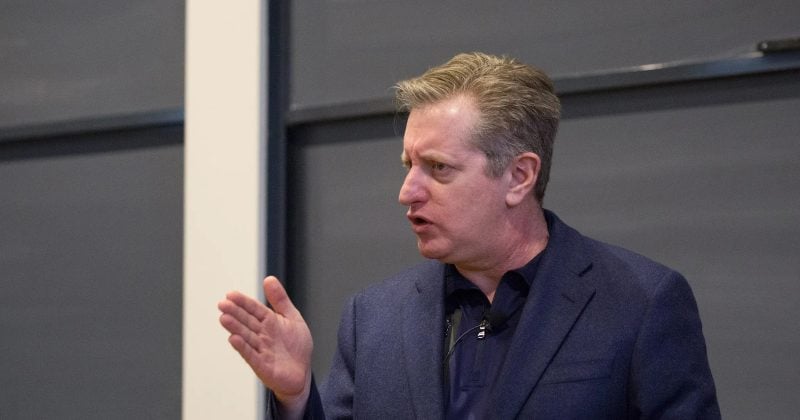
Via coinpaper.com
Steve Eisman expresses doubts about AI, sells key tech stock
The investor who called the 2008 housing crash is getting nervous about AI's trillion-dollar spending spree, and he's putting his money where his mouth is.
Steve Eisman, the investor immortalized in “The Big Short” for betting against the housing market before it imploded in 2008, is now turning his skeptical eye toward artificial intelligence.
The case against the AI hype machine
Back in December 2025, during an appearance on CNBC’s Squawk Box, Eisman flagged a concern that most AI bulls would rather not discuss. He argued that performance improvements in large language models would begin to slow as they scale. That observation alone made him “nervous,” as he put it. But at the time, he explicitly said he wasn’t selling any AI stocks he owned.
By June 2026, his tone had sharpened considerably. Eisman turned his criticism toward the companies pouring enormous sums into AI infrastructure, specifically calling out hyperscalers like Alphabet and Microsoft. His core argument is that these companies are spending trillions on AI capabilities, but many of them lack the competitive moats needed to justify those expenditures.
Follow the picks and shovels
Rather than abandoning the AI trade entirely, Eisman has drawn a sharp distinction between different layers of the AI stack. His preferred play sits further down the supply chain: chip suppliers like Nvidia, the companies providing the foundational infrastructure that every AI builder needs regardless of who ultimately wins the application layer war.
Eisman also took a memorable swipe at SpaceX’s anticipated IPO, criticizing its heavy reliance on speculative AI applications. In a comparison that probably didn’t sit well in Silicon Valley, he juxtaposed SpaceX’s revenue profile with that of Kellogg’s, the cereal company, to highlight just how disconnected some tech valuations have become from underlying business fundamentals.
AI, tech, and the markets they move—in one daily briefing.
Daily. Free. Join 34,000+ readers across crypto, finance, and policy.
What the Big Short guy’s skepticism means for crypto
The crypto market has become deeply intertwined with the AI narrative. Decentralized compute networks like Render and Akash have positioned themselves as the picks-and-shovels layer of AI infrastructure. If Eisman’s framework proves correct, and the value in AI accrues to infrastructure providers rather than application builders, these protocols could theoretically benefit from the same logic that makes him bullish on Nvidia.
However, Eisman’s entire thesis rests on the idea that competitive moats matter. Most crypto AI projects are open-source by design, which makes building moats even harder than it is for Alphabet or Microsoft.
As of July 2026, no public filings indicate a sale of a tech stock by Eisman related to his AI skepticism.