
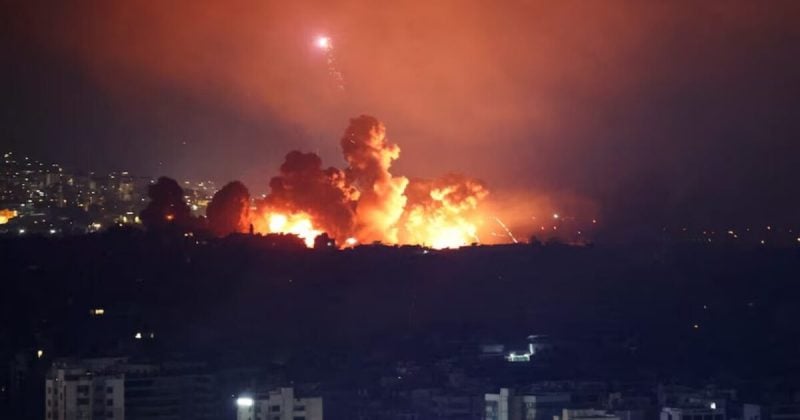
Israel’s Iran military campaign rattles oil markets and sends crypto volatility surging
Netanyahu's vow to press on with military operations against Iran is creating ripple effects across energy markets, inflation expectations, and crypto trading behavior
Benjamin Netanyahu has made one thing clear: the military campaign against Iran is not winding down. The Israeli Prime Minister has pledged to continue operations regardless of where US-led diplomatic conversations land, a posture that is keeping global markets on edge and giving crypto traders plenty to think about.
The conflict traces back to strikes that began in late February 2026, and what followed was a cascade of market reactions that illustrated just how quickly geopolitical shocks travel from traditional finance into crypto.
From the Strait of Hormuz to your trading terminal
After Iranian aggression in the Strait of Hormuz disrupted a fragile ceasefire, hostilities resumed and oil markets moved sharply.
The crypto market felt it almost immediately. Bitcoin dropped from roughly $68,000 to roughly $63,000 in the days surrounding the initial strikes in late February, before recovering back above $67,000 by early March. Ethereum tracked a similar pattern, with both assets exhibiting risk-off behavior.
On March 7, Netanyahu pledged to continue the war “with all our force” alongside the US, a statement that landed in markets already processing the initial shock of the conflict’s opening weeks.
Macro, rates, and crypto—what moved markets and what matters next.
Daily. Free. Join 34,000+ readers across crypto, finance, and policy.
The $10.3 million signal from Iranian exchanges
One of the more telling data points from the conflict’s early phase came from crypto outflows. Between the Saturday and Monday following the March 2026 strikes, $10.3 million in crypto left Iranian exchanges, with over $2 million of that moving in the first hour alone.
On the derivatives side, Hyperliquid, a decentralized perpetuals exchange, saw trading volume for oil-linked contracts spike to nearly $200 million immediately after the initial strikes.
Oil, inflation, and the Fed’s uncomfortable position
The broader economic concern layered on top of all this is inflation. Oil price spikes feed directly into transportation costs, which feed into the price of almost everything else. If sustained military operations keep supply routes through the Strait of Hormuz disrupted, the inflationary pressure that follows could force central banks to reassess policy paths they had already mapped out.
Netanyahu framed the campaign in June as a potential precursor to regime change in Iran, adding a layer of strategic uncertainty that extends well beyond any near-term ceasefire timeline.
What investors should actually watch
A few things are worth tracking closely. First, oil price trajectories will be the leading indicator for inflation expectations, which in turn will shape central bank language, which will move crypto markets. Second, continued outflows from exchanges in sanctioned or conflict-affected jurisdictions could signal capital flight into crypto. Third, when traditional commodity markets are closed on weekends and decentralized exchanges are processing $200 million in oil-contract volume, that is an argument about utility that is harder to dismiss than most crypto utility arguments tend to be.