Skip to content
Advertisement
Federal Reserve Chairman Kevin Warsh shifts investor expectations with key remarks on price stability

Federal Reserve Chairman Kevin Warsh shifts investor expectations with key remarks on price stability

Six words from the new Fed chair sent markets scrambling and forced Wall Street to rethink its rate outlook for the rest of 2026

Bank of America Corporation (BAC) price

Full chart and stats

Loading chart…

Market cap
$355.6B (shares as of 2026-07-30)
P/E (trailing)
11.7 (EPS to 2026-06-30)
Annual revenue
$113.1B USD (FY ended 2025-12-31) 10-K
Annual revenue growth
+6.8% (FY ended 2025-12-31 vs FY ended 2024-12-31) 10-K
Annual net income
30,509,000,000 USD (FY ended 2025-12-31, attributable to the company) 10-K
Annual operating margin
Unavailable
Forward P/E
Unavailable: no dated forecast source

Gloria daily close for session Oct 28, 2026. Market cap and trailing P/E use this close with the SEC share total and trailing diluted earnings, each dated next to its figure. Annual revenue, revenue growth, net income and margin show their own fiscal period and link the 10-K. Current context may postdate this article.

Bank of America Corporation and its peers

Company PriceMarket capP/E (trailing)Forward P/EAnnual revenue (USD)Annual revenue growthAnnual net income (USD)Operating margin
Bank of America Corporation BAC · Price dated Oct 28, 2026 · tokenized BACx $51$355.6B11.7Unavailable$113.1BFY ended 2025-12-31 · 10-K+6.8%FY ended 2025-12-31 vs 2024-12-31 · 10-K30,509,000,000FY ended 2025-12-31, attributable to the company · 10-KUnavailable
Wells Fargo & Company WFC · Price dated Oct 28, 2026 $84$251.2B11.8Unavailable$83.7BFY ended 2025-12-31 · 10-K+1.7%FY ended 2025-12-31 vs 2024-12-31 · 10-K21,338,000,000FY ended 2025-12-31, attributable to the company · 10-KUnavailable
Citigroup Inc. C · Price dated Oct 28, 2026 $124$208.2B13.4Unavailable$85.2BFY ended 2025-12-31 · 10-K+5.6%FY ended 2025-12-31 vs 2024-12-31 · 10-K14,306,000,000FY ended 2025-12-31, attributable to the company · 10-KUnavailable
JPMorgan Chase & Co. JPM · Price dated Oct 28, 2026 · tokenized JPMx $339$901.9B14.5Unavailable$182.4BFY ended 2025-12-31 · 10-K+2.8%FY ended 2025-12-31 vs 2024-12-31 · 10-K57,048,000,000FY ended 2025-12-31, attributable to the company · 10-KUnavailable

Missing figures stay unavailable. Forward P/E requires a dated source. Annual revenue, revenue growth, net income and margin come from each company's own 10-K, in US dollars, and each row shows that fiscal year. Revenue growth compares the fiscal year with the prior year stated in the same 10-K. Net income is the full year amount attributable to the company, or available to common stockholders where the filing states only that, or consolidated net income. Each row names its basis. Trailing P/E reads "Not meaningful" when the dated trailing diluted EPS is a loss or zero. An operating margin appears only when the filing states both the operating income and the revenue for the same year.

Sources: SEC filings, Gloria daily closes and CoinGecko. Oldest record refresh: Oct 28, 2026, 5:41 PM EDT. Refresh is not a price or filing date. Each row shows its price date and its annual fiscal period. Peers use industry code and company size, or editorial selection. Market cap multiplies that row price by the company share total the latest SEC filing states for every share class together. Trailing P/E divides it by trailing diluted earnings from SEC filings. Rolled earnings per share are approximate because share counts can change between periods. Both appear only when the SEC data carries its date, so they are estimates at one price date, not synchronized filing valuations. Not investment advice.

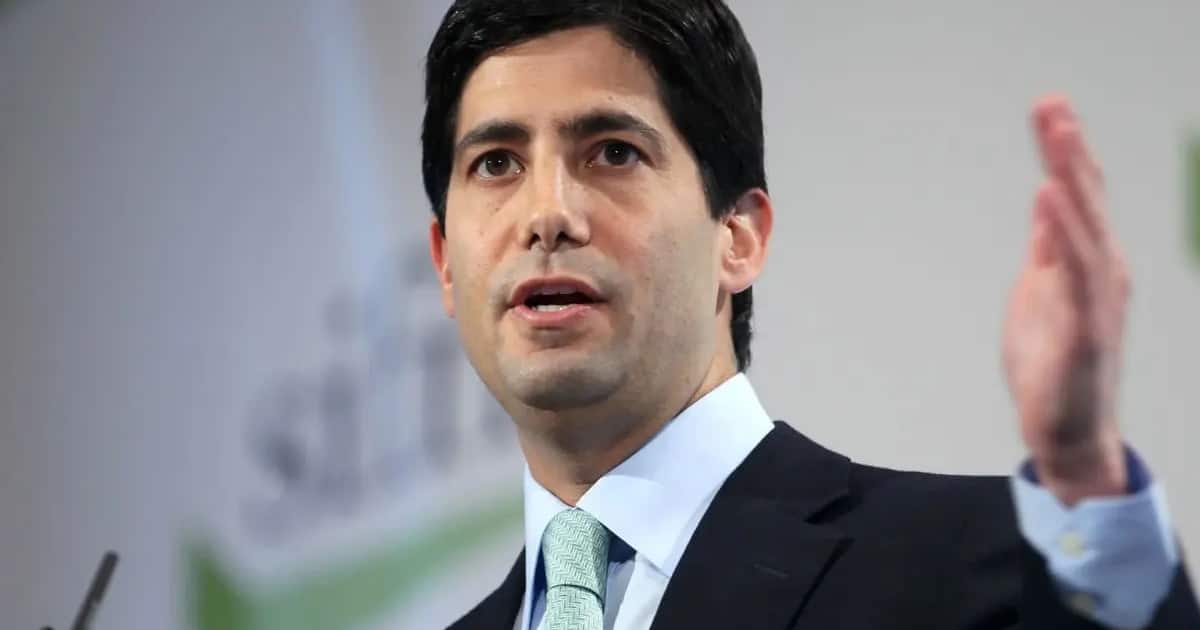
Kevin Warsh has been Fed Chair for less than a month, and he’s already rewriting the playbook. During his first post-FOMC press conference on June 17, 2026, Warsh delivered a statement so concise it could fit in a tweet: “The Committee will deliver price stability.”

Six words. That’s all it took to send traders scrambling, force Bank of America to revise its rate projections, and trigger a sharp but temporary selloff in Bitcoin and other risk assets.

What happened and why it matters

The FOMC held the federal funds rate steady at 3.5-3.75% during the June meeting, which was largely expected. The surprise wasn’t the rate decision itself. It was the tone.

Warsh, who took office on May 22 after a razor-thin 54-45 Senate confirmation vote, used his first public remarks to reassert the Fed’s commitment to its 2% inflation target. The phrasing was deliberate and unambiguous, a stark departure from the carefully hedged language that characterized the Jerome Powell years.

Advertisement

Bank of America wasted no time adjusting. The bank raised its 2026 interest rate hike forecast to three, up from its previous projection.

The reaction in crypto was swift and predictable. Bitcoin dropped sharply in the immediate aftermath of the hawkish signals, as traders repriced the likelihood of tighter monetary conditions ahead. But then Bitcoin recovered above $60,000 after Warsh indicated that inflation risks had moderated.

A new communication style takes shape

Warsh is reducing forward guidance, the practice of telegraphing future policy moves well in advance. Instead, he’s emphasizing a data-dependent approach where each economic release could meaningfully shift the policy calculus.

Warsh has also launched internal task forces to review Fed operations, signaling that the institutional changes may run deeper than just communication.

What this means for crypto investors

The market is simultaneously processing two competing narratives. First, Warsh is committed to price stability, which means he’ll hike rates if inflation doesn’t cooperate, a negative for risk assets. Second, he acknowledged that inflation risks have decreased, suggesting the economy might not need aggressive tightening right now.

If Bank of America’s revised forecast of three rate hikes in 2026 proves accurate, crypto markets could face sustained headwinds. Higher rates strengthen the dollar, increase the yield on risk-free assets like Treasuries, and reduce the incentive to park capital in volatile stores of value like Bitcoin.

The reduced forward guidance adds another layer of complexity. Under Powell, crypto traders could position ahead of well-telegraphed rate decisions with reasonable confidence. Under Warsh, that confidence evaporates.
Disclosure: This article was edited by Editorial Team. For more information on how we create and review content, see our Editorial Policy.

More in Finance

See all
Previous storySouth Korea plans massive investment fund to ride the AI semiconductor boom