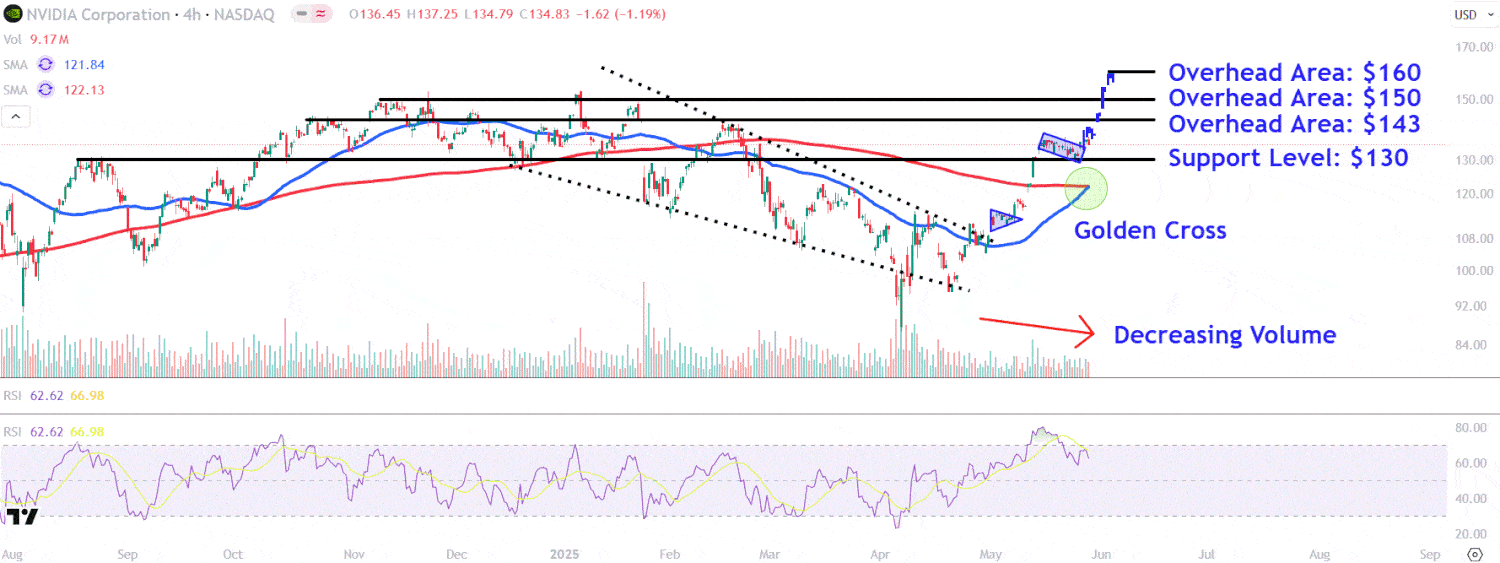
The chip giant's Q1 FY27 results arrive as Wall Street braces for another volatility event from the company that has become AI's financial heartbeat.
Nvidia’s fiscal Q1 FY27 earnings are set to drop after the bell on May 28, 2025, and the options market is pricing in a roughly 4.87% swing in either direction. For a company with Nvidia’s market cap, that implied move translates to hundreds of billions of dollars in value shifting on a single print.
The expected move sits comfortably within Nvidia’s recent post-earnings pattern. This is a stock that has trained investors to expect fireworks every quarter, and the options premiums reflect that conditioning.
The numbers Wall Street is watching
Nvidia heads into this report riding momentum that would make most companies blush. In Q4 of fiscal year 2026, the company posted $68.1B in revenue, a 73% jump compared to the same period a year earlier. That number alone is staggering, but the composition tells the real story.
Data center revenue hit $62.3B in that same quarter, climbing 75% year-over-year. In English: roughly 91 cents of every dollar Nvidia earned came from selling chips and systems to companies building out AI infrastructure. The remaining revenue streams, gaming, automotive, professional visualization, are almost rounding errors at this point.
For the full fiscal year 2026, Nvidia delivered revenue growth of 65%. That kind of top-line expansion at Nvidia’s scale is historically unusual for any semiconductor company. It speaks to just how much capital is flowing into AI buildouts across hyperscalers, enterprise customers, and sovereign AI initiatives.
Here’s the thing. Despite those blockbuster results, Nvidia’s stock has shown a pattern of post-earnings volatility that doesn’t always reward bulls. After the FY26 results landed, shares experienced notable choppiness as investors weighed whether the company’s cash generation was keeping pace with the enormous expectations baked into the stock price.
Why a chip company matters to crypto
Nvidia’s earnings have become a macro event that ripples well beyond traditional tech equities. The company sits at the intersection of several narratives that crypto investors care deeply about.
First, Nvidia’s GPU dominance in AI training and inference has made it the picks-and-shovels play of the AI gold rush. Many crypto-native projects focused on decentralized compute, GPU rental marketplaces, and AI-blockchain integrations derive their fundamental value proposition from the scarcity and demand for exactly the hardware Nvidia produces. When Nvidia reports strong data center numbers, it validates the thesis that GPU compute is a scarce and valuable resource, which is bullish for tokens tied to decentralized GPU networks.
Second, Nvidia’s results serve as a sentiment barometer for risk assets broadly. A strong beat tends to lift the entire risk-on trade, including Bitcoin and major altcoins. A miss or weak guidance can trigger the opposite. The correlation isn’t perfect, but it’s consistent enough that crypto traders mark Nvidia earnings on their calendars alongside FOMC meetings and CPI prints.
Third, the AI narrative itself has become deeply intertwined with crypto market sentiment. Projects building at the intersection of AI and blockchain have attracted significant capital, and Nvidia’s quarterly updates provide a reality check on whether the broader AI spending cycle is accelerating or showing signs of fatigue.
What investors should actually focus on
The raw revenue number will grab headlines, but several second-order details deserve closer attention for anyone trying to gauge where this story goes next.
Guidance matters more than the backward-looking print. Nvidia’s forward commentary on data center demand, supply chain constraints, and new product ramp timelines (particularly around its Blackwell architecture) will set the tone for the next quarter’s trading range. If management signals any deceleration in orders or pushback from hyperscaler customers, the 4.87% implied move could prove conservative on the downside.
Gross margins are the other watchpoint. Nvidia has maintained extraordinary margin profiles, but new product transitions and competitive pressure from AMD and custom silicon efforts at major cloud providers could compress those margins over time. Any margin guidance below expectations would likely trigger a sharper selloff than a modest revenue miss.
The company’s last quarterly cash dividend was $0.01 per share, scheduled for payment on April 1, 2026. Nobody is owning Nvidia for the dividend yield. That token payout is essentially a rounding error, reinforcing that this remains a pure growth story where investors are paying for future earnings expansion, not current income.
For crypto market participants, the key question is whether Nvidia’s results reinforce or undermine the AI spending supercycle narrative. A strong report with robust forward guidance would likely support risk appetite across digital assets, particularly AI-adjacent tokens. A disappointment could create a short-term headwind for the entire risk asset complex, crypto included, as traders reassess the durability of the AI trade that has been lifting boats across multiple asset classes for over two years now.