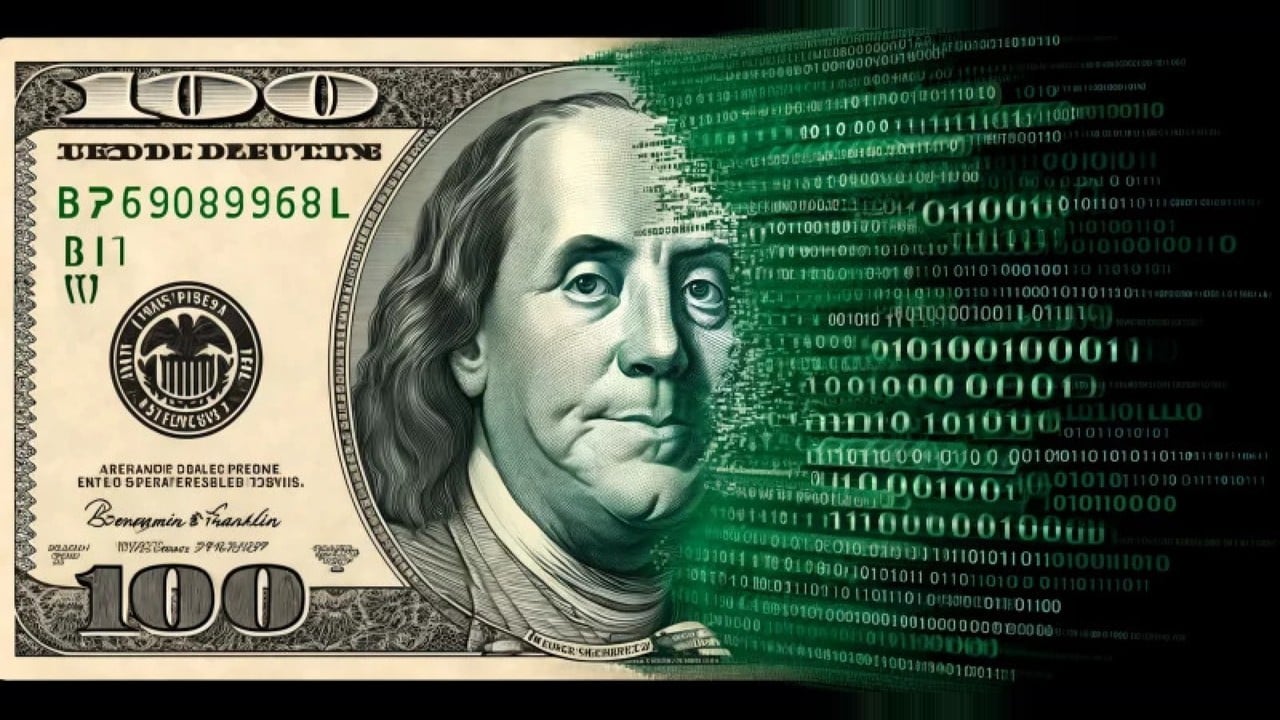
Open Standard leads stablecoin market cap growth with $794M in OUSD
The payments consortium backed by Coinbase, Mastercard, Shopify, Stripe, and Visa posted the largest 30-day supply gain of any stablecoin issuer
Coinbase Global, Inc. (COIN) price
Full chart and statsLoading chart…
- Last close
- $161
- Close-to-close change
- +0.9%
- Market cap
- $42.5B (shares as of 2026-06-30)
- P/E (trailing)
- Not meaningful: trailing loss. Diluted EPS −3.79 for 2025-07-01 to 2026-06-30, rolled from reported annual and year-to-date EPS (approximate) SEC filing
- Annual revenue
- $7.2B USD (FY ended 2025-12-31) 10-K
- Annual revenue growth
- +9.4% (FY ended 2025-12-31 vs FY ended 2024-12-31) 10-K
- Annual net income
- 1,260,327,000 USD (FY ended 2025-12-31, attributable to the company) 10-K
- Annual operating margin
- 20.0% (FY ended 2025-12-31)
- Forward P/E
- Unavailable: no dated forecast source
Gloria daily close for session Oct 27, 2026. Market cap and trailing P/E use this close with the SEC share total and trailing diluted earnings, each dated next to its figure. Annual revenue, revenue growth, net income and margin show their own fiscal period and link the 10-K. Current context may postdate this article.
Coinbase Global, Inc. and its peers
| Company | Price | Market cap | P/E (trailing) | Forward P/E | Annual revenue (USD) | Annual revenue growth | Annual net income (USD) | Operating margin |
|---|---|---|---|---|---|---|---|---|

|
|
$161 | $42.5B | Not meaningfulLoss, diluted EPS −3.79 to 2026-06-30 · SEC filing | Unavailable | $7.2BFY ended 2025-12-31 · 10-K | +9.4%FY ended 2025-12-31 vs 2024-12-31 · 10-K | 1,260,327,000FY ended 2025-12-31, attributable to the company · 10-K | 20.0%FY ended 2025-12-31 |

|
|
$141 | Unavailable | Not meaningfulLoss, diluted EPS −96.98 to 2026-06-30 · SEC filing | Unavailable | $477.2MFY ended 2025-12-31 · 10-K | +3.0%FY ended 2025-12-31 vs 2024-12-31 · 10-K | −3,848,152,000FY ended 2025-12-31, attributable to the company · 10-K | −1,140.8%FY ended 2025-12-31 |

|
|
$82 | Unavailable | 16.3 | Unavailable | $2.7BFY ended 2025-12-31 · 10-K | +63.9%FY ended 2025-12-31 vs 2024-12-31 · 10-K | −69,508,000FY ended 2025-12-31, attributable to the company · 10-K | −3.5%FY ended 2025-12-31 |
|
|
$22 | $13.0B | Not meaningfulLoss, diluted EPS −4.50 to 2026-05-31 · SEC filing | Unavailable | $6.1MFY ended 2025-08-31 · 10-K | +84.1%FY ended 2025-08-31 vs 2024-08-31 · 10-K | 348,577,000FY ended 2025-08-31, attributable to the company · 10-K | 7,288.1%FY ended 2025-08-31 |

Missing figures stay unavailable. Forward P/E requires a dated source. Annual revenue, revenue growth, net income and margin come from each company's own 10-K, in US dollars, and each row shows that fiscal year. Revenue growth compares the fiscal year with the prior year stated in the same 10-K. Net income is the full year amount attributable to the company, or available to common stockholders where the filing states only that, or consolidated net income. Each row names its basis. Trailing P/E reads "Not meaningful" when the dated trailing diluted EPS is a loss or zero. An operating margin appears only when the filing states both the operating income and the revenue for the same year.
Sources: SEC filings, Gloria daily closes and CoinGecko. Oldest record refresh: Oct 27, 2026, 8:36 PM EDT. Refresh is not a price or filing date. Each row shows its price date and its annual fiscal period. Peers use industry code and company size, or editorial selection. Market cap multiplies that row price by the company share total the latest SEC filing states for every share class together. Trailing P/E divides it by trailing diluted earnings from SEC filings. Rolled earnings per share are approximate because share counts can change between periods. Both appear only when the SEC data carries its date, so they are estimates at one price date, not synchronized filing valuations. Not investment advice.
Open Standard topped every stablecoin issuer in 30-day market cap growth, adding $794 million in its Open USD (OUSD) token, according to Token Terminal data reported on October 28, 2026.
For a token that launched less than a month earlier, that is a fast start. The 30-day window covers almost the entire life of the product, which makes the number both impressive and a little unfair to everyone it beat.
OUSD went live on September 30, 2026. Its founding partners are Coinbase, Mastercard, Shopify, Stripe, and Visa, a lineup that reads less like a crypto startup’s cap table and more like the guest list for a payments industry summit.
From launch to the top of the leaderboard
OUSD launched simultaneously on four blockchains: Ethereum, Base, Solana, and Tempo. At launch, its market cap sat at approximately $468 to $477 million.
Within the first week, that figure climbed to around $668 million. Estimates from the first days after launch put the market cap in the $666 to $668 million range.
The climb did not stall there. By mid-October, OUSD had crossed the $800 million mark, and DefiLlama data showed it at approximately $828 million by October 28, 2026.
Stablecoin market cap tracks how many tokens are in circulation, so growth here means real dollars being deposited and converted, not traders bidding up a price.
The news moving money, markets, and the world—before your day starts.
Daily. Free. Join 34,000+ readers across crypto, finance, and policy.
Why Tempo holds most of the supply
The distribution across chains is lopsided. Approximately 64% of OUSD’s supply, or more than $500 million, sits on the Tempo blockchain as of mid-to-late October.
Tempo is backed by Stripe and other significant partners. Given that Stripe is also one of OUSD’s founding partners, the concentration looks less like a coincidence and more like a home-field advantage.
The remaining supply is spread across Ethereum, Base, and Solana.
A different kind of stablecoin business model
Open Standard is positioning OUSD as shared infrastructure for payments and programmable finance. The research behind the launch frames it as distinct from tokens built primarily for crypto trading.
Minting and redemption cost nothing, and users can swap OUSD for US dollars at a 1:1 ratio through partner platforms.
Coinbase, Mastercard, Shopify, Stripe, and Visa each hold equal equity stakes in the venture, so no single company runs the show.
Open Standard returns most reserve income to its partners rather than keeping it, which gives the partner network a direct financial reason to push adoption.
Reserves backing OUSD are held at BlackRock, Lead Bank, and BNY Mellon. Open Standard publishes month-to-month reserve attestations, which are periodic reports confirming that the dollars backing the tokens actually exist.
Initial commitments exceeded $1 billion in liquidity from a partner network of more than 200 companies.
Disclosure: This article was edited by Kaye Quema. For more information on how we create and review content, see our Editorial Policy.

