
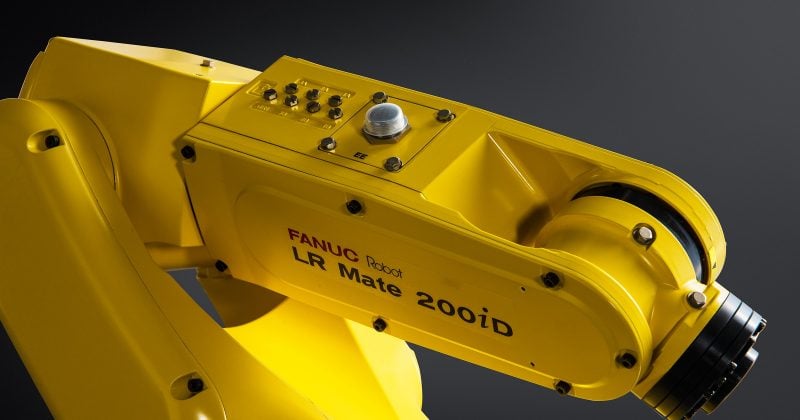
Via fanucamerica.com
Fanuc Corp. shares plunge after profit outlook misses expectations, raising questions about industrial automation demand
The world's dominant factory robot maker posted strong quarterly profits but couldn't convince investors its full-year outlook was ambitious enough.
Fanuc Corp., the Japanese company that builds roughly 65% of the world’s computerized numerical control (CNC) systems, just watched its stock crater in the most dramatic fashion in four decades. The culprit wasn’t bad earnings. It was earnings that weren’t good enough.
The company raised its full-year operating income forecast to 218 billion yen, which sounds like good news until you learn that analysts were expecting something closer to 226 billion yen. That 8 billion yen gap, roughly $55 million at current exchange rates, was enough to send shares spiraling and reignite fears about rising material costs eating into margins across the global manufacturing sector.
Strong quarter, weak conviction
Here’s the thing about Fanuc’s actual results: they were genuinely solid. First-quarter net profit for fiscal year 2026 came in at 50.981 billion yen, a 35% jump from the 37.844 billion yen posted in the same period a year earlier. Revenue hit 231.035 billion yen.
Shares on the Tokyo Stock Exchange, where Fanuc trades under ticker 6954.T, have been hovering around 7,135 yen amid the volatility. The scale of the single-day decline marked the worst session for the stock in roughly 40 years.
Why crypto investors should pay attention to a robot company
Fanuc has an established partnership with NVIDIA to integrate AI capabilities into its industrial robots. NVIDIA, of course, is the company whose GPUs power both the AI revolution and a significant chunk of the world’s crypto mining infrastructure. When a major NVIDIA partner signals that material costs are climbing and demand visibility is murky, it sends a signal through the entire hardware supply chain, one that eventually touches GPU production, data center buildouts, and the physical infrastructure underpinning proof-of-work mining operations.
AI, tech, and the markets they move—in one daily briefing.
Daily. Free. Join 34,000+ readers across crypto, finance, and policy.
Rising input costs for industrial manufacturers also serve as a broader inflation signal. If raw material prices are climbing fast enough to make a company with 65% global market share in its core product nervous about margins, that’s a data point worth watching for anyone tracking macro conditions.
The bigger picture on industrial automation
Fanuc’s guidance miss lands at an awkward moment for the global automation sector. The company’s decision to raise its outlook by less than expected suggests that even dominant market players are struggling to pass rising material costs through to customers, or at least aren’t confident they can do so consistently over the next several quarters.
As Fanuc integrates more AI into its robotics platform via its NVIDIA partnership, any supply chain disruption or cost pressure that affects Fanuc’s ability to deploy AI-enhanced manufacturing equipment could indirectly constrain the broader ecosystem of AI hardware production, including the GPUs that crypto miners covet.