
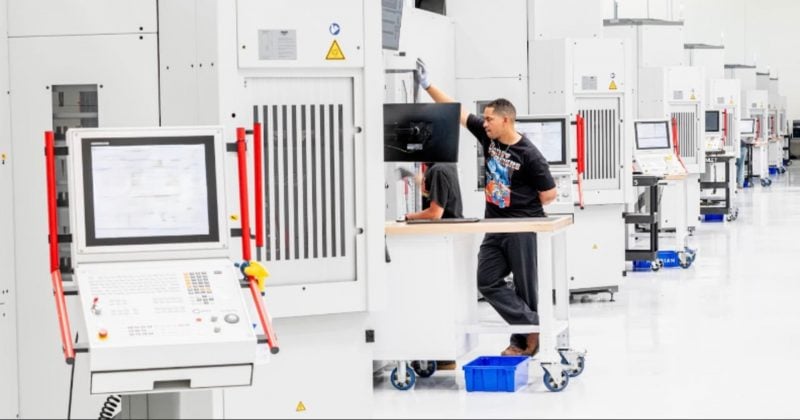
Via nbcdfw.com
Hadrian secures $7.87B valuation with $1.37B raise to supercharge defense manufacturing
The AI-powered factory startup is betting big on mega factories and workforce expansion as US defense spending accelerates
Hadrian Automation just closed a $1.37B Series D round, pushing the defense manufacturing startup’s valuation to $7.87B. For a company founded in 2020, that’s the kind of trajectory that makes venture capitalists very happy and competitors very nervous.
The round, which closed on August 6, was co-led by WCM Investment Management, Washington Harbour Partners, Valor Equity Partners, 137 Ventures, and Baillie Gifford, with JPMorgan also reportedly involved.
From $1.6B to $7.87B in months
The company’s valuation sat at roughly $1.6B not long ago. Now it’s nearly five times that figure. Earlier speculation in June 2026 pegged the company at a potential $7.5B valuation, but the final number came in even higher.
The Series D follows a $260M Series C round completed in July 2025. Total funding now exceeds $1.9B.
Hadrian is plowing capital into expanding its physical manufacturing footprint and advancing its Opus AI platform. Opus is the company’s proprietary system that integrates software, automation, and artificial intelligence to run factories with minimal human intervention, producing precision aerospace and defense components at a pace and consistency that traditional machine shops can’t match.
AI, tech, and the markets they move—in one daily briefing.
Daily. Free. Join 34,000+ readers across crypto, finance, and policy.
The factory expansion playbook
The company’s newest facility, Factory 3 in Mesa, Arizona, spans between 270,000 and 290,000 square feet. That single location has already created more than 350 jobs.
Hadrian’s total manufacturing footprint has ballooned to nearly 3 million square feet. CEO Chris Power has laid out plans to build between 10 and 20 mega factories.
The components Hadrian manufactures, precision parts for rockets, satellites, and naval systems, are exactly the kind of products where supply chain fragility keeps defense officials up at night.
The company has also started venturing into additive manufacturing, commonly known as 3D printing for industrial applications, broadening its capabilities beyond traditional CNC machining.