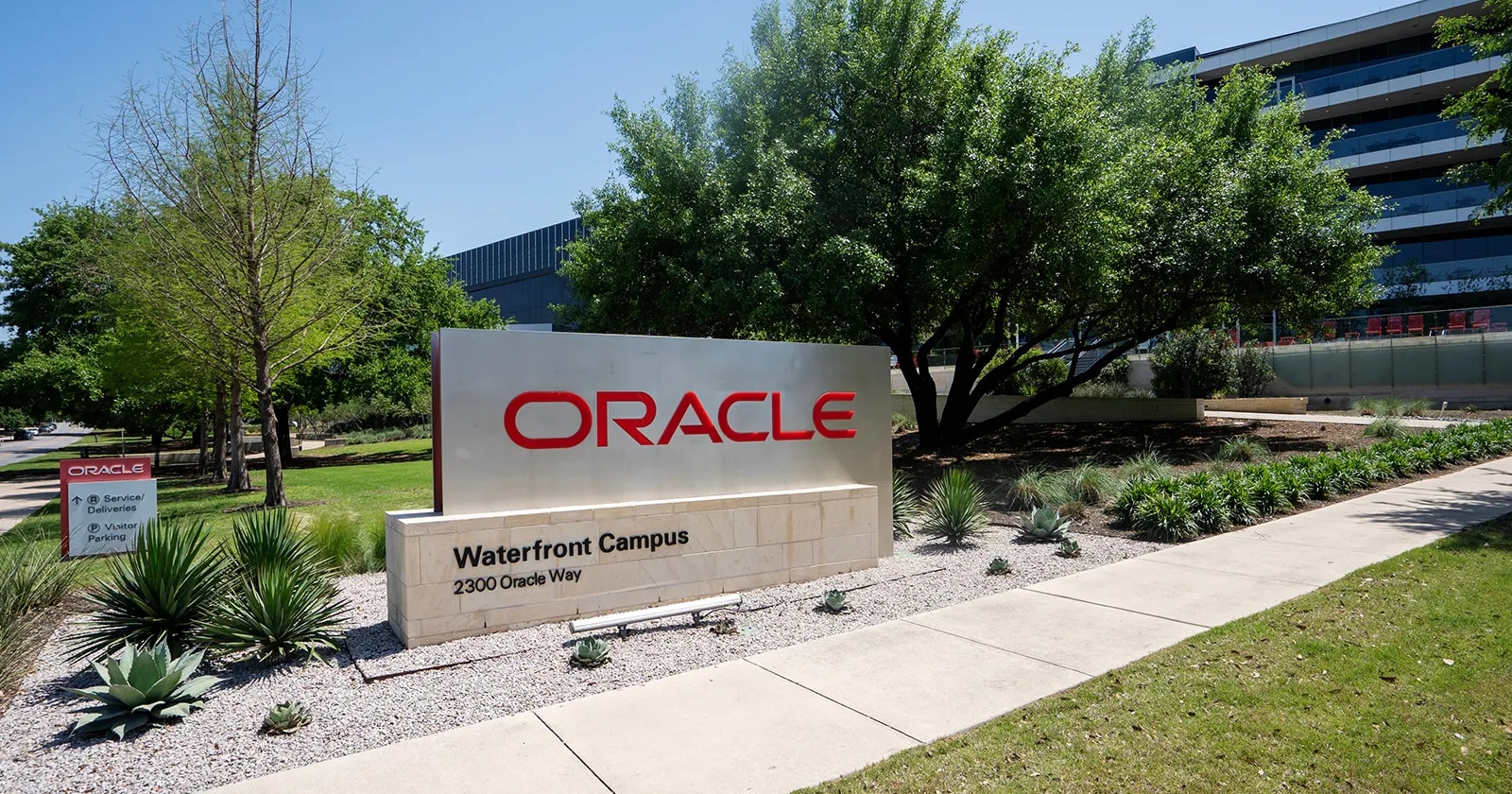
Oracle awarded $395.8M US contract to overhaul government-wide HR software
The decade-long deal will consolidate over 100 fragmented systems serving nearly 2 million federal employees into a single cloud platform
Oracle Corporation (ORCL) price
Full chart and statsLoading chart…
- Last close
- $131
- Close-to-close change
- +3.5%
- Market cap
- $394.7B (shares as of 2026-09-07)
- P/E (trailing)
- 20.5 (EPS to 2026-08-31)
- Annual revenue
- $67.4B USD (FY ended 2026-05-31) 10-K
- Annual revenue growth
- +17.3% (FY ended 2026-05-31 vs FY ended 2025-05-31) 10-K
- Annual net income
- 17,087,000,000 USD (FY ended 2026-05-31, attributable to the company) 10-K
- Annual operating margin
- 30.6% (FY ended 2026-05-31)
- Forward P/E
- Unavailable: no dated forecast source
Gloria daily close for session Oct 27, 2026. Market cap and trailing P/E use this close with the SEC share total and trailing diluted earnings, each dated next to its figure. Annual revenue, revenue growth, net income and margin show their own fiscal period and link the 10-K. Current context may postdate this article.
Oracle Corporation and its peers
| Company | Price | Market cap | P/E (trailing) | Forward P/E | Annual revenue (USD) | Annual revenue growth | Annual net income (USD) | Operating margin |
|---|---|---|---|---|---|---|---|---|
|
|
$131 | $394.7B | 20.5 | Unavailable | $67.4BFY ended 2026-05-31 · 10-K | +17.3%FY ended 2026-05-31 vs 2025-05-31 · 10-K | 17,087,000,000FY ended 2026-05-31, attributable to the company · 10-K | 30.6%FY ended 2026-05-31 |
|
|
$199 | $477.5B | 169.9 | Unavailable | $4.5BFY ended 2025-12-31 · 10-K | +56.2%FY ended 2025-12-31 vs 2024-12-31 · 10-K | 1,625,033,000FY ended 2025-12-31, attributable to the company · 10-K | 31.6%FY ended 2025-12-31 |
|
|
$268 | $274.4B | Not meaningfulLoss, diluted EPS −0.45 to 2026-07-31 · SEC filing | Unavailable | $4.8BFY ended 2026-01-31 · 10-K | +21.7%FY ended 2026-01-31 vs 2025-01-31 · 10-K | −162,502,000FY ended 2026-01-31, attributable to the company · 10-K | −6.1%FY ended 2026-01-31 |
|
|
$166 | Unavailable | 112.0 | Unavailable | $11.6BFY ended 2025-12-31 · 10-K | +30.1%FY ended 2025-12-31 vs 2024-12-31 · 10-K | 1,231,000,000FY ended 2025-12-31, attributable to the company · 10-K | 12.7%FY ended 2025-12-31 |

Missing figures stay unavailable. Forward P/E requires a dated source. Annual revenue, revenue growth, net income and margin come from each company's own 10-K, in US dollars, and each row shows that fiscal year. Revenue growth compares the fiscal year with the prior year stated in the same 10-K. Net income is the full year amount attributable to the company, or available to common stockholders where the filing states only that, or consolidated net income. Each row names its basis. Trailing P/E reads "Not meaningful" when the dated trailing diluted EPS is a loss or zero. An operating margin appears only when the filing states both the operating income and the revenue for the same year.
Sources: SEC filings, Gloria daily closes and CoinGecko. Oldest record refresh: Oct 28, 2026, 3:36 PM EDT. Refresh is not a price or filing date. Each row shows its price date and its annual fiscal period. Peers use industry code and company size, or editorial selection. Market cap multiplies that row price by the company share total the latest SEC filing states for every share class together. Trailing P/E divides it by trailing diluted earnings from SEC filings. Rolled earnings per share are approximate because share counts can change between periods. Both appear only when the SEC data carries its date, so they are estimates at one price date, not synchronized filing valuations. Not investment advice.
Oracle just landed one of the most significant federal IT contracts in recent memory. The US Office of Personnel Management (OPM) awarded the enterprise software giant a $395.8 million contract to build a unified, cloud-based human resources platform for the federal government.
The deal spans 10 years and aims to replace more than 100 existing HR systems currently scattered across federal agencies. Those systems serve approximately 2 million federal employees, which means Oracle is essentially becoming the HR backbone for the entire US government workforce.
What the deal actually looks like
The contract was awarded on June 10, 2026, following a competitive procurement process that stretched over a year. OPM, led by Director Scott Kupor, evaluated multiple vendors through hands-on testing, market research, and live demonstrations.
Workday was among the competitors evaluated during the process. Oracle won out.
The initiative falls under what’s being called the Federal HR 2.0 strategy. The goal is straightforward: streamline HR processes, cut redundancy, and drag federal workforce management into the modern era of cloud computing. The Trump administration has positioned this as a centerpiece of its broader technology modernization agenda.
AI, tech, and the markets they move—in one daily briefing.
Daily. Free. Join 34,000+ readers across crypto, finance, and policy.
For context, $395.8 million over a decade works out to roughly $40 million per year.
What crypto investors should actually take from this
The deal contains zero references to cryptocurrency, blockchain technology, or any decentralized infrastructure. This is a pure-play cloud computing win for Oracle, full stop.
The federal government’s largest HR modernization effort in years chose a centralized cloud solution without even a nod toward blockchain-based identity, credentialing, or payroll systems.
Disclosure: This article was edited by Editorial Team. For more information on how we create and review content, see our Editorial Policy.
More in Technology
See all-
AA-Robotics v0.1 puts frontier language models in charge of a robot arm
-
Microsoft CFO projects about $170 billion in capital expenditures this year
-
Wall Street moves past the Fed pause and back to tech earnings and AI
-
Perplexity taps OpenAI’s gpt-live-1 to power its voice mode
-
Microsoft Foundry passes 120,000 customers as revenue more than triples
-
Satya Nadella says AI agents now open over 40% of GitHub pull requests