
Prime Intellect unveils Prime Agent, a self-improving coding harness that outperforms human experts on key AI benchmark

Via primeintellect.ai

Prime Intellect unveils Prime Agent, a self-improving coding harness that outperforms human experts on key AI benchmark

The open-source tool treats code context as a living variable, scoring 95.5% on ARC-AGI-3 and marking a new chapter for autonomous AI development

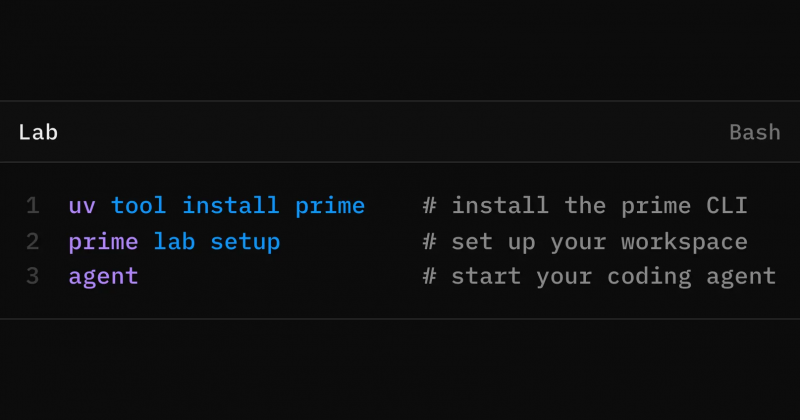
Prime Intellect, the distributed AI infrastructure startup that hit a $1 billion valuation just last month, dropped something genuinely interesting this week. Prime Agent is an open-source, self-improving coding harness built on what’s called a Recursive Language Model framework. In English: it’s a tool that lets AI agents write code, test it, learn from the results, and modify their own behavior, all without a human hovering over the keyboard.

Prime Intellect closed a $130 million Series A in July 2026, bringing total funding north of $150 million. Investors including Radical Ventures, NVIDIA Ventures, and Intel Capital clearly wanted to see what all that capital could produce. Prime Agent appears to be the first major answer.

How the RLM framework actually works

The core innovation is something called a Continual Harness. Instead of treating each coding task as a discrete, stateless interaction, Prime Agent runs inside a persistent Python REPL, a live coding environment where context carries over from one step to the next.

Advertisement

Within this persistent environment, the RLM framework treats context itself as a variable. The model can programmatically call tools, spin up sub-agents for delegated tasks, and critically, modify its own approach based on what’s working and what isn’t. No static prompts required.

This builds on foundational research by Alex Zhang, who first outlined the RLM concept in a blog post back in October 2025 before formalizing it in an arXiv paper. Prime Intellect took that theoretical framework and turned it into production-ready infrastructure.

Benchmark results that got people’s attention

Using Opus 5 as its underlying model, the system scored 95.5% on the ARC-AGI-3 benchmark, a benchmark specifically designed to test abstract reasoning and novel problem-solving. A 95.5% score surpasses established human-expert baselines, meaning the system outperformed the humans that the benchmark was calibrated against.

Prime Intellect had already been building the infrastructure backbone for this moment. The launch follows deployment of its verifiers stack, version one, and the creation of hundreds of thousands of sandboxed environments through its Environment Hub.

What this means for the AI landscape and adjacent markets

Prime Intellect is betting that democratizing this capability creates more value than gatekeeping it. Startups and enterprise teams can now build on top of Prime Agent without licensing fees or vendor lock-in.

The $1 billion valuation Prime Intellect achieved post-Series A signals something about where venture capital sees the next wave of AI value creation: shifting from foundation models themselves toward the infrastructure and tooling layers that make those models useful in production. Prime Agent sits squarely in that layer.

Disclosure: This article was edited by Editorial Team. For more information on how we create and review content, see our Editorial Policy.

Prime Intellect unveils Prime Agent, a self-improving coding harness that outperforms human experts on key AI benchmark

Prime Intellect unveils Prime Agent, a self-improving coding harness that outperforms human experts on key AI benchmark

The open-source tool treats code context as a living variable, scoring 95.5% on ARC-AGI-3 and marking a new chapter for autonomous AI development

Via primeintellect.ai

Prime Intellect, the distributed AI infrastructure startup that hit a $1 billion valuation just last month, dropped something genuinely interesting this week. Prime Agent is an open-source, self-improving coding harness built on what’s called a Recursive Language Model framework. In English: it’s a tool that lets AI agents write code, test it, learn from the results, and modify their own behavior, all without a human hovering over the keyboard.

Prime Intellect closed a $130 million Series A in July 2026, bringing total funding north of $150 million. Investors including Radical Ventures, NVIDIA Ventures, and Intel Capital clearly wanted to see what all that capital could produce. Prime Agent appears to be the first major answer.

How the RLM framework actually works

The core innovation is something called a Continual Harness. Instead of treating each coding task as a discrete, stateless interaction, Prime Agent runs inside a persistent Python REPL, a live coding environment where context carries over from one step to the next.

Advertisement

Within this persistent environment, the RLM framework treats context itself as a variable. The model can programmatically call tools, spin up sub-agents for delegated tasks, and critically, modify its own approach based on what’s working and what isn’t. No static prompts required.

This builds on foundational research by Alex Zhang, who first outlined the RLM concept in a blog post back in October 2025 before formalizing it in an arXiv paper. Prime Intellect took that theoretical framework and turned it into production-ready infrastructure.

Benchmark results that got people’s attention

Using Opus 5 as its underlying model, the system scored 95.5% on the ARC-AGI-3 benchmark, a benchmark specifically designed to test abstract reasoning and novel problem-solving. A 95.5% score surpasses established human-expert baselines, meaning the system outperformed the humans that the benchmark was calibrated against.

Prime Intellect had already been building the infrastructure backbone for this moment. The launch follows deployment of its verifiers stack, version one, and the creation of hundreds of thousands of sandboxed environments through its Environment Hub.

What this means for the AI landscape and adjacent markets

Prime Intellect is betting that democratizing this capability creates more value than gatekeeping it. Startups and enterprise teams can now build on top of Prime Agent without licensing fees or vendor lock-in.

The $1 billion valuation Prime Intellect achieved post-Series A signals something about where venture capital sees the next wave of AI value creation: shifting from foundation models themselves toward the infrastructure and tooling layers that make those models useful in production. Prime Agent sits squarely in that layer.

Disclosure: This article was edited by Editorial Team. For more information on how we create and review content, see our Editorial Policy.