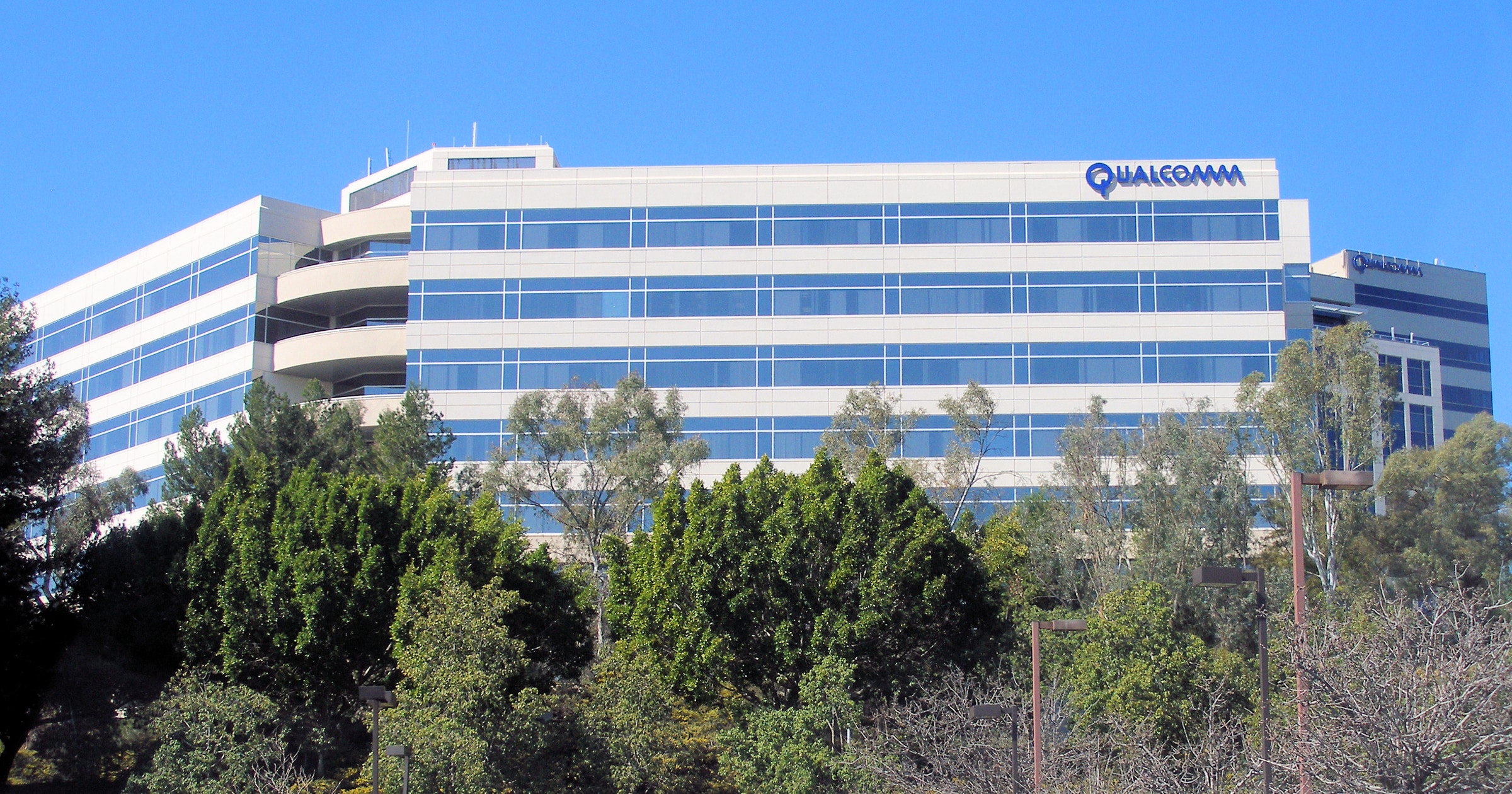
Qualcomm issues weak profit forecast as AI data centers steal memory chips from smartphones
Photo: Coolcaesar at en.wikipedia / Wikimedia Commons / CC BY-SA 3.0 (https://creativecommons.org/licenses/by-sa/3.0)
The chipmaker beat Q1 estimates but guided well below Wall Street expectations for next quarter, sending shares down 11% after hours
QUALCOMM Incorporated (QCOM) price
Full chart and statsLoading chart…
- Last close
- $184
- Close-to-close change
- +2.5%
- Market cap
- $193.4B (shares as of 2026-07-27)
- P/E (trailing)
- 21.0 (EPS to 2026-06-28)
- Annual revenue
- $44.3B USD (FY ended 2025-09-28) 10-K
- Annual revenue growth
- +13.7% (FY ended 2025-09-28 vs FY ended 2024-09-29) 10-K
- Annual net income
- 5,541,000,000 USD (FY ended 2025-09-28, attributable to the company) 10-K
- Annual operating margin
- 27.9% (FY ended 2025-09-28)
- Forward P/E
- Unavailable: no dated forecast source
Gloria daily close for session Oct 27, 2026. Market cap and trailing P/E use this close with the SEC share total and trailing diluted earnings, each dated next to its figure. Annual revenue, revenue growth, net income and margin show their own fiscal period and link the 10-K. Current context may postdate this article.
QUALCOMM Incorporated and its peers
| Company | Price | Market cap | P/E (trailing) | Forward P/E | Annual revenue (USD) | Annual revenue growth | Annual net income (USD) | Operating margin |
|---|---|---|---|---|---|---|---|---|
|
|
$184 | $193.4B | 21.0 | Unavailable | $44.3BFY ended 2025-09-28 · 10-K | +13.7%FY ended 2025-09-28 vs 2024-09-29 · 10-K | 5,541,000,000FY ended 2025-09-28, attributable to the company · 10-K | 27.9%FY ended 2025-09-28 |
|
|
$866 | $77.7B | Not meaningfulLoss, diluted EPS −92.96 to 2026-06-27 · SEC filing | Unavailable | $3.0BFY ended 2026-06-27 · 10-K | +83.2%FY ended 2026-06-27 vs 2025-06-28 · 10-K | −6,935,100,000FY ended 2026-06-27, attributable to the company · 10-K | 17.4%FY ended 2026-06-27 |
|
|
$425 | $206.1B | 50.5 | Unavailable | $11.0BFY ended 2025-11-01 · 10-K | +16.9%FY ended 2025-11-01 vs 2024-11-02 · 10-K | 2,267,342,000FY ended 2025-11-01, attributable to the company · 10-K | 26.6%FY ended 2025-11-01 |
|
|
$895 | $236.9B | 23.5 | Unavailable | $38.1BFY ended 2025-12-31 · 10-K | +9.0%FY ended 2025-12-31 vs 2024-12-31 · 10-K | 4,884,000,000FY ended 2025-12-31, attributable to the company · 10-K | 3.6%FY ended 2025-12-31 |

Missing figures stay unavailable. Forward P/E requires a dated source. Annual revenue, revenue growth, net income and margin come from each company's own 10-K, in US dollars, and each row shows that fiscal year. Revenue growth compares the fiscal year with the prior year stated in the same 10-K. Net income is the full year amount attributable to the company, or available to common stockholders where the filing states only that, or consolidated net income. Each row names its basis. Trailing P/E reads "Not meaningful" when the dated trailing diluted EPS is a loss or zero. An operating margin appears only when the filing states both the operating income and the revenue for the same year.
Sources: SEC filings and Gloria daily closes. Oldest record refresh: Oct 28, 2026, 3:41 PM EDT. Refresh is not a price or filing date. Each row shows its price date and its annual fiscal period. Peers use industry code and company size, or editorial selection. Market cap multiplies that row price by the company share total the latest SEC filing states for every share class together. Trailing P/E divides it by trailing diluted earnings from SEC filings. Rolled earnings per share are approximate because share counts can change between periods. Both appear only when the SEC data carries its date, so they are estimates at one price date, not synchronized filing valuations. Not investment advice.
Qualcomm just delivered a classic earnings plot twist: beat the quarter, tank on the guidance. The chipmaker posted fiscal Q1 2026 results that topped Wall Street estimates, then immediately followed up with a profit forecast weak enough to send shares tumbling as much as 11% in after-hours trading.
The numbers tell two very different stories
Qualcomm’s fiscal Q1 2026 looked solid on paper. Adjusted earnings per share came in at $3.50, beating the $3.41 consensus. Revenue hit $12.25 billion against expectations of $12.21 billion.
For Q2 fiscal 2026, Qualcomm guided revenue between $10.2 billion and $11 billion. Wall Street had been expecting $11.11 billion. The adjusted EPS forecast of $2.45 to $2.65 landed even further below the $2.89 consensus.
AI is eating everyone’s lunch, including smartphones
Qualcomm CEO Cristiano Amon pointed directly at surging demand from AI data centers as the primary driver. The massive buildout of AI infrastructure requires enormous quantities of memory chips, and that demand has essentially redirected critical memory supplies away from the smartphone sector.
The impact has been particularly acute among smaller Chinese smartphone manufacturers, who lack the purchasing power and supply chain leverage of giants like Apple or Samsung. Reduced production and lower inventory levels among these OEMs translate directly into fewer Qualcomm chips being shipped.
AI, tech, and the markets they move—in one daily briefing.
Daily. Free. Join 34,000+ readers across crypto, finance, and policy.
Qualcomm has announced plans for double-digit price increases effective September 1, 2026, specifically tied to rising memory costs.
What this means for investors and the broader tech ecosystem
The revision suggests the memory shortage could persist through a significant portion of fiscal 2026. Qualcomm has been working to diversify beyond smartphones into automotive, IoT, and PC chips, but the handset business remains its bread and butter, and a prolonged shortage in that segment creates real revenue headwinds that diversification alone can’t offset in the near term.
The planned double-digit price hikes starting in September 2026 deserve particular scrutiny. Higher component costs tend to compress margins across the supply chain. If smartphone prices rise meaningfully, it could dampen unit sales growth in emerging markets.
Traders should watch two things closely in the coming quarters: whether the memory shortage shows signs of easing as new fabrication capacity comes online, and whether Qualcomm’s price increases stick or get negotiated down by large OEMs with leverage.
Disclosure: This article was edited by Editorial Team. For more information on how we create and review content, see our Editorial Policy.
More in Technology
See all-
OpenAI offers up to $500 in monthly API credits to ChatGPT Pro and Business subscribers
-
Grass founder says network can’t keep up with AI data demand
-
AA-Robotics v0.1 puts frontier language models in charge of a robot arm
-
Microsoft CFO projects about $170 billion in capital expenditures this year
-
Wall Street moves past the Fed pause and back to tech earnings and AI
-
Perplexity taps OpenAI’s gpt-live-1 to power its voice mode