Ratepayer Protection Act would force AI companies to fund their own energy upgrades, and crypto miners should pay attention
A bipartisan bill targeting data centers consuming 100 megawatts or more could set a precedent for how energy-intensive industries, including crypto mining, bear infrastructure costs.
+22.2% (FY ended 2025-12-31 vs FY ended 2024-12-31) 10-K
Annual net income
60,458,000,000 USD (FY ended 2025-12-31, attributable to the company) 10-K
Annual operating margin
41.4% (FY ended 2025-12-31)
Forward P/E
Unavailable: no dated forecast source
Gloria daily close for session Oct 28, 2026. Market cap and trailing P/E use this close with the SEC share total and trailing diluted earnings, each dated next to its figure. Annual revenue, revenue growth, net income and margin show their own fiscal period and link the 10-K. Current context may postdate this article.
3,333,751,000FY ended 2025-12-31, attributable to the company · 10-K
75.8%FY ended 2025-12-31
Missing figures stay unavailable. Forward P/E requires a dated source. Annual revenue, revenue growth, net income and margin come from each company's own 10-K, in US dollars, and each row shows that fiscal year. Revenue growth compares the fiscal year with the prior year stated in the same 10-K. Net income is the full year amount attributable to the company, or available to common stockholders where the filing states only that, or consolidated net income. Each row names its basis. Trailing P/E reads "Not meaningful" when the dated trailing diluted EPS is a loss or zero. An operating margin appears only when the filing states both the operating income and the revenue for the same year.
Sources: SEC filings, Gloria daily closes and CoinGecko. Oldest record refresh: Oct 28, 2026, 4:51 PM EDT. Refresh is not a price or filing date. Each row shows its price date and its annual fiscal period. Peers use industry code and company size, or editorial selection. Market cap multiplies that row price by the company share total the latest SEC filing states for every share class together. Trailing P/E divides it by trailing diluted earnings from SEC filings. Rolled earnings per share are approximate because share counts can change between periods. Both appear only when the SEC data carries its date, so they are estimates at one price date, not synchronized filing valuations. Not investment advice.
Token vs underlying stock
Current comparison for META. Historical observations may postdate this article.
Split-adjusted regular-session stock closes from the existing Gloria shared history, paired only with an observed token price within 45 minutes of 16:00 New York time. Up to 60 matched sessions. No interpolation or missing-date fill. Weekends and known early closes are omitted. Token units are not adjusted for issuer multipliers or dividend treatment. This compares quoted prices, not fair value, executable premiums or arbitrage returns. Solid line: token. Dashed line: stock. Exact quote times and values appear below. Historical observations. Retrieval refers to the token source. Token quote times use UTC. The fixed cohort shows its oldest member fetch.
Meta token vs Meta stock: exact source values
Date (UTC)
Token (USD)
Stock close (USD)
Token quote (UTC)
2026-08-05
590.76
588.77
2026-08-05 20:00
2026-08-06
589.91
589.90
2026-08-06 20:00
2026-08-07
592.96
592.10
2026-08-07 20:00
2026-08-10
595.64
594.92
2026-08-10 20:00
2026-08-11
600.42
599.12
2026-08-11 20:00
2026-08-12
580.52
578.85
2026-08-12 20:00
2026-08-13
595.84
594.97
2026-08-13 20:00
2026-08-14
590.73
589.85
2026-08-14 20:00
2026-08-17
569.77
568.97
2026-08-17 20:00
2026-08-18
544.97
543.67
2026-08-18 20:00
2026-08-19
547.78
546.03
2026-08-19 20:00
2026-08-20
547.56
545.83
2026-08-20 20:00
2026-08-21
551.35
549.90
2026-08-21 20:00
2026-08-24
560.74
559.02
2026-08-24 20:00
2026-08-25
571.26
570.05
2026-08-25 20:00
2026-08-26
577.62
576.14
2026-08-26 20:00
2026-08-27
572.41
571.10
2026-08-27 20:00
2026-08-28
579.18
578.02
2026-08-28 20:00
2026-08-31
573.08
572.34
2026-08-31 20:00
2026-09-01
579.55
578.54
2026-09-01 20:00
2026-09-02
593.44
592.85
2026-09-02 20:00
2026-09-03
612.22
610.68
2026-09-03 20:00
2026-09-04
617.78
616.77
2026-09-04 20:00
2026-09-08
614.55
613.48
2026-09-08 20:00
2026-09-09
653.99
653.69
2026-09-09 20:00
2026-09-10
645.68
644.38
2026-09-10 20:00
2026-09-11
648.82
648.03
2026-09-11 20:00
2026-09-14
667.33
665.60
2026-09-14 20:00
2026-09-15
671.72
670.24
2026-09-15 20:00
2026-09-16
674.78
673.31
2026-09-16 20:00
2026-09-17
683.69
682.31
2026-09-17 20:00
2026-09-18
667.45
665.75
2026-09-18 20:00
2026-09-21
743.56
741.25
2026-09-21 20:00
2026-09-22
740.44
736.60
2026-09-22 20:00
2026-09-23
746.35
744.10
2026-09-23 20:00
2026-09-24
778.30
777.59
2026-09-24 20:00
2026-09-25
752.94
751.66
2026-09-25 20:00
2026-09-28
716.77
715.62
2026-09-28 20:00
2026-09-29
741.08
738.79
2026-09-29 20:00
2026-09-30
728.60
725.18
2026-09-30 20:00
2026-10-01
727.20
725.93
2026-10-01 20:00
2026-10-02
729.17
728.08
2026-10-02 20:00
2026-10-05
743.97
741.90
2026-10-05 20:00
2026-10-06
741.44
738.88
2026-10-06 20:00
2026-10-07
722.75
721.31
2026-10-07 20:00
2026-10-08
722.91
720.89
2026-10-08 20:00
2026-10-09
720.22
718.67
2026-10-09 20:00
2026-10-12
744.29
742.96
2026-10-12 20:00
2026-10-13
764.47
762.50
2026-10-13 20:00
2026-10-14
737.37
737.54
2026-10-14 20:00
2026-10-15
738.03
736.72
2026-10-15 20:00
2026-10-16
711.14
709.33
2026-10-16 20:00
2026-10-19
707.00
705.44
2026-10-19 20:00
2026-10-20
695.35
694.25
2026-10-20 20:00
2026-10-21
700.90
697.52
2026-10-21 20:00
2026-10-22
650.24
648.85
2026-10-22 20:00
2026-10-23
643.78
642.62
2026-10-23 20:00
2026-10-26
631.24
630.56
2026-10-26 20:00
2026-10-27
621.46
620.19
2026-10-27 20:00
2026-10-28
612.89
612.49
2026-10-28 20:00
Stock history: Gloria · Retrieved Oct 29, 00:31 UTC. Token history: CoinGecko METAx.
Quoted token and share units can have different rights, multipliers and dividend treatment. This is not an executable premium or arbitrage signal.
Congress just told Big Tech to pay its own electricity bill. The Ratepayer Protection Act, a bipartisan federal bill introduced on June 18, 2026, would require large-load electricity consumers, primarily AI data centers, to cover all incremental costs of grid upgrades needed to support their operations.
What the bill actually does
H.R. 9340, introduced by Rep. Gabe Evans (R-CO) and co-sponsored by Rep. Kathy Castor (D-FL), targets what it classifies as “large-load customers.” That means anyone requiring 100 megawatts or more of electricity. In English: that’s roughly enough power to supply 80,000 homes simultaneously.
The legislation mandates state regulators to implement special rates or agreements ensuring these mega-consumers pay for the grid infrastructure their operations demand. No more socializing the cost of a new substation across grandma’s utility bill because Meta needed another data center in rural Virginia.
Rep. Brett Guthrie (R-KY), chairman of the House Energy and Commerce Committee, has been a vocal supporter. He’s framed the bill as striking a balance between encouraging technological progress and keeping electricity affordable for regular households and small businesses.
The bill has already cleared a House subcommittee vote and is heading toward full Energy and Commerce Committee consideration.
The news moving money, markets, and the world—before your day starts.
Daily. Free. Join 34,000+ readers across crypto, finance, and policy.
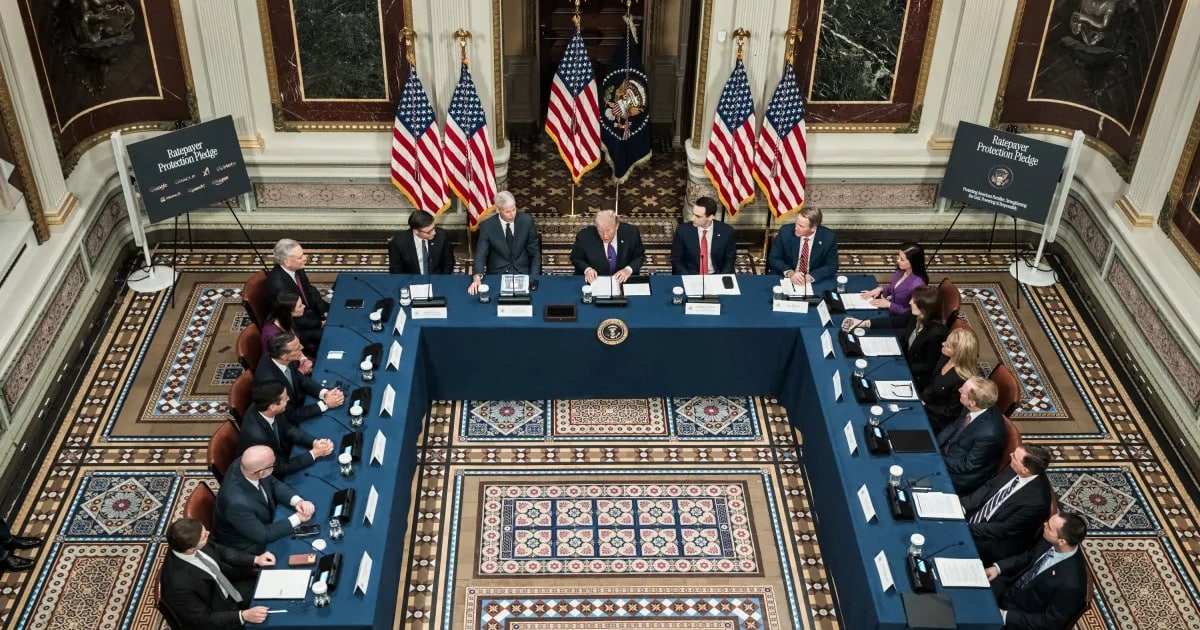
The White House laid the groundwork on March 4, 2026, with its Ratepayer Protection Pledge. Major tech companies including Meta, Google, and xAI voluntarily committed to taking responsibility for their energy needs and associated infrastructure costs. Think of the pledge as the handshake. The Ratepayer Protection Act is the contract.
While state measures concerning similar issues have surfaced, the Ratepayer Protection Act represents a comprehensive federal approach aimed at establishing a standardized national framework for large electricity consumers.
Why crypto should care
The bill’s language targets entities consuming 100 MW or more, and it’s explicitly aimed at AI data centers. Large-scale Bitcoin mining operations are among the most energy-intensive industrial activities in the country. While individual mining facilities may fall below the 100 MW threshold today, the precedent this legislation sets could reshape how policymakers think about any industry that places outsized demands on the power grid.
The Ratepayer Protection Act establishes the principle that large energy consumers can’t externalize infrastructure costs onto residential ratepayers. That principle doesn’t have an AI-shaped boundary. It has a megawatt-shaped boundary.
Disclosure: This article was edited by Editorial Team. For more information on how we create and review content, see our Editorial Policy.