
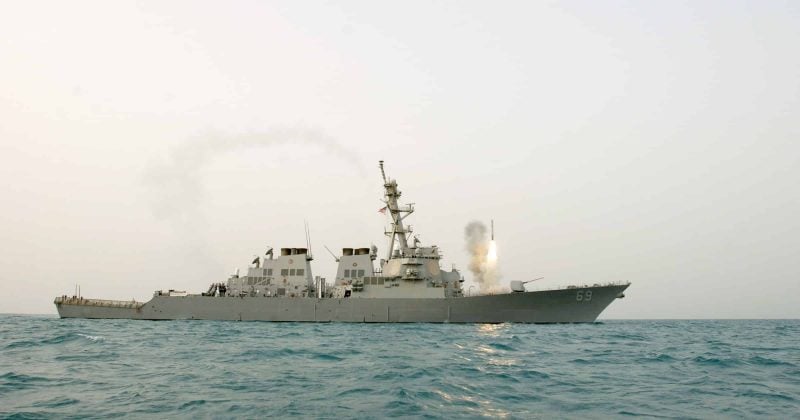
US deploys over 20 Navy warships in Middle East amid Iran tensions

https://en.wikipedia.org/wiki/Arleigh_Burke-class_destroyer

US deploys over 20 Navy warships in Middle East amid Iran tensions

Bab el-Mandeb strait closure dates

The United States Central Command (CENTCOM) announced that more than 20 US Navy warships are currently patrolling waters across the Middle East. This deployment, which includes naval warships and aircraft transiting the Arabian Sea in a show of force, is part of ongoing efforts to enhance regional security and stability. The move comes amid heightened tensions between the United States and Iran, following recent exchanges of attacks and the expiration of a memorandum of understanding. The deployment’s timing also coincides with the broader context of the 2026 Iran and Lebanon wars, further underscoring the escalation in military presence in the region.

Advertisement

Key Takeaways

  • The reported deployment of over 20 US Navy warships in the Middle East appears to be a significant military maneuver, suggesting increased tensions in the region.
  • Market pricing indicates a possible rise in the perceived risk of disruptions in the Bab el-Mandeb Strait, reflecting a 20% expected move toward a YES outcome for closure by September 30.
  • The US naval presence is consistent with scenarios where military actions may escalate, impacting regional security dynamics and trade routes.

What to Watch

Markets are closely monitoring developments involving the US and Iranian military actions and any official statements from key actors such as Abdul-Malik al-Houthi and Iranian leadership. The likelihood of disruptions in the Bab el-Mandeb Strait may increase if further military maneuvers or conflicts are reported. Additionally, insurance companies and commercial operators’ reactions could provide further indications of potential movements. Watch for any shifts in the US Navy’s operational status and related geopolitical developments.

Get prediction market intelligence as a structured API feed. Early access waitlist.

Disclosure: This article was edited by Estefano Gomez. For more information on how we create and review content, see our Editorial Policy.

US deploys over 20 Navy warships in Middle East amid Iran tensions

US deploys over 20 Navy warships in Middle East amid Iran tensions

Bab el-Mandeb strait closure dates

https://en.wikipedia.org/wiki/Arleigh_Burke-class_destroyer

The United States Central Command (CENTCOM) announced that more than 20 US Navy warships are currently patrolling waters across the Middle East. This deployment, which includes naval warships and aircraft transiting the Arabian Sea in a show of force, is part of ongoing efforts to enhance regional security and stability. The move comes amid heightened tensions between the United States and Iran, following recent exchanges of attacks and the expiration of a memorandum of understanding. The deployment’s timing also coincides with the broader context of the 2026 Iran and Lebanon wars, further underscoring the escalation in military presence in the region.

Advertisement

Key Takeaways

  • The reported deployment of over 20 US Navy warships in the Middle East appears to be a significant military maneuver, suggesting increased tensions in the region.
  • Market pricing indicates a possible rise in the perceived risk of disruptions in the Bab el-Mandeb Strait, reflecting a 20% expected move toward a YES outcome for closure by September 30.
  • The US naval presence is consistent with scenarios where military actions may escalate, impacting regional security dynamics and trade routes.

What to Watch

Markets are closely monitoring developments involving the US and Iranian military actions and any official statements from key actors such as Abdul-Malik al-Houthi and Iranian leadership. The likelihood of disruptions in the Bab el-Mandeb Strait may increase if further military maneuvers or conflicts are reported. Additionally, insurance companies and commercial operators’ reactions could provide further indications of potential movements. Watch for any shifts in the US Navy’s operational status and related geopolitical developments.

Get prediction market intelligence as a structured API feed. Early access waitlist.

Disclosure: This article was edited by Estefano Gomez. For more information on how we create and review content, see our Editorial Policy.