
World Cup final melee highlights the high-stakes emotions that mirror crypto market volatility

World Cup final melee highlights the high-stakes emotions that mirror crypto market volatility

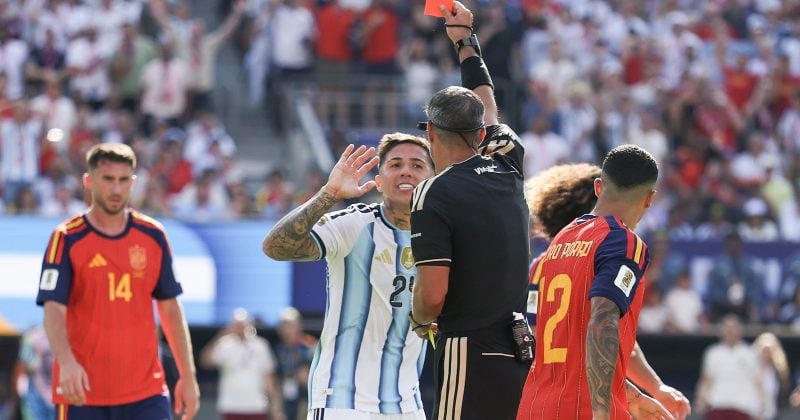
Argentina's Leandro Paredes earned a red card for shoving Spain's Gavi after the 2026 World Cup final, a reminder that high-pressure environments breed irrational behavior, whether on the pitch or in financial markets.

The 2026 FIFA World Cup final ended with Spain lifting the trophy after a 1-0 victory over Argentina at MetLife Stadium. But the lasting image from July 19 wasn’t Faren Torres’s extra-time winner in the 106th minute. It was the ugly brawl that followed the final whistle, punctuated by Argentine midfielder Leandro Paredes receiving a red card for shoving Spain’s Gavi.

What actually happened on the pitch

Spain and Argentina played 90 minutes of scoreless football before Torres broke through in the 106th minute of extra time. That goal gave Spain the World Cup, and it apparently gave several Argentine players a reason to lose their composure entirely.

Paredes shoved Gavi after the match concluded, earning himself a post-game red card. Paredes reportedly grabbed Spain’s Eric Garcia by the throat during the melee. Nahuel Molina, another Argentine player, allegedly attempted to punch Rodri amid the chaos. Major sports outlets described the scenes as disgraceful.

Advertisement

Why this matters beyond sports

When humans face sudden, high-magnitude losses, they don’t process the situation rationally. They lash out. They make impulsive decisions. In crypto, this manifests as panic selling at the bottom, doubling down on losing leveraged positions, or rage-tweeting about market manipulation when a trade goes sideways.

Paredes didn’t change the scoreline by shoving Gavi. He just earned himself a red card, potential disciplinary sanctions, and a permanent footnote as the guy who couldn’t handle losing.

Daniel Kahneman’s prospect theory, the foundational work that earned him a Nobel Prize, demonstrates that losses feel roughly twice as painful as equivalent gains feel good. A 1-0 World Cup final loss, after 106 minutes of deadlock, is about as concentrated a dose of loss aversion as you can manufacture in a sporting context.

The institutional angle

There’s a governance dimension here too. FIFA’s post-match disciplinary process will determine what additional sanctions Paredes, Molina, and potentially other Argentine players face.

When FTX collapsed in November 2022, the immediate aftermath was chaotic. The actual accountability process took years to work through courts and regulatory bodies. FIFA operates on a compressed timeline compared to the SEC, but the principle is identical: the moment of crisis reveals character, and the institutional response determines whether the system maintains credibility.

Rodri, who was reportedly targeted by Molina’s attempted punch, is widely regarded as one of the most composed midfielders in world football. Firms like Jump Trading and Wintermute operate with mechanical precision. Individual traders who blow up their accounts on leverage typically share the emotional profile of someone who shoves an opponent after the final whistle has already blown.

Disclosure: This article was edited by Editorial Team. For more information on how we create and review content, see our Editorial Policy.

World Cup final melee highlights the high-stakes emotions that mirror crypto market volatility

World Cup final melee highlights the high-stakes emotions that mirror crypto market volatility

Argentina's Leandro Paredes earned a red card for shoving Spain's Gavi after the 2026 World Cup final, a reminder that high-pressure environments breed irrational behavior, whether on the pitch or in financial markets.

The 2026 FIFA World Cup final ended with Spain lifting the trophy after a 1-0 victory over Argentina at MetLife Stadium. But the lasting image from July 19 wasn’t Faren Torres’s extra-time winner in the 106th minute. It was the ugly brawl that followed the final whistle, punctuated by Argentine midfielder Leandro Paredes receiving a red card for shoving Spain’s Gavi.

What actually happened on the pitch

Spain and Argentina played 90 minutes of scoreless football before Torres broke through in the 106th minute of extra time. That goal gave Spain the World Cup, and it apparently gave several Argentine players a reason to lose their composure entirely.

Paredes shoved Gavi after the match concluded, earning himself a post-game red card. Paredes reportedly grabbed Spain’s Eric Garcia by the throat during the melee. Nahuel Molina, another Argentine player, allegedly attempted to punch Rodri amid the chaos. Major sports outlets described the scenes as disgraceful.

Advertisement

Why this matters beyond sports

When humans face sudden, high-magnitude losses, they don’t process the situation rationally. They lash out. They make impulsive decisions. In crypto, this manifests as panic selling at the bottom, doubling down on losing leveraged positions, or rage-tweeting about market manipulation when a trade goes sideways.

Paredes didn’t change the scoreline by shoving Gavi. He just earned himself a red card, potential disciplinary sanctions, and a permanent footnote as the guy who couldn’t handle losing.

Daniel Kahneman’s prospect theory, the foundational work that earned him a Nobel Prize, demonstrates that losses feel roughly twice as painful as equivalent gains feel good. A 1-0 World Cup final loss, after 106 minutes of deadlock, is about as concentrated a dose of loss aversion as you can manufacture in a sporting context.

The institutional angle

There’s a governance dimension here too. FIFA’s post-match disciplinary process will determine what additional sanctions Paredes, Molina, and potentially other Argentine players face.

When FTX collapsed in November 2022, the immediate aftermath was chaotic. The actual accountability process took years to work through courts and regulatory bodies. FIFA operates on a compressed timeline compared to the SEC, but the principle is identical: the moment of crisis reveals character, and the institutional response determines whether the system maintains credibility.

Rodri, who was reportedly targeted by Molina’s attempted punch, is widely regarded as one of the most composed midfielders in world football. Firms like Jump Trading and Wintermute operate with mechanical precision. Individual traders who blow up their accounts on leverage typically share the emotional profile of someone who shoves an opponent after the final whistle has already blown.

Disclosure: This article was edited by Editorial Team. For more information on how we create and review content, see our Editorial Policy.