
AlphaFold AI redesigns gene-editing proteins to enhance safety, and biotech investors should pay attention

AlphaFold AI redesigns gene-editing proteins to enhance safety, and biotech investors should pay attention

A new AI framework called ContactSeek uses AlphaFold3 to engineer safer gene-editing tools, with implications that stretch far beyond the lab

Google DeepMind’s AlphaFold has already won a Nobel Prize for cracking the protein-folding problem. Now researchers are using its successor, AlphaFold3, to solve one of gene therapy’s most persistent headaches: the tendency of gene-editing tools to accidentally cut the wrong DNA.

A study published on July 22, 2026, in Nature introduces ContactSeek, a framework that leverages AlphaFold3’s structural predictions to redesign base editors, the molecular scissors used to make precise changes to individual DNA letters. The result is gene-editing proteins that are dramatically more accurate than existing high-fidelity alternatives, while still getting the job done on the sequences they’re supposed to edit.

Advertisement

How ContactSeek actually works

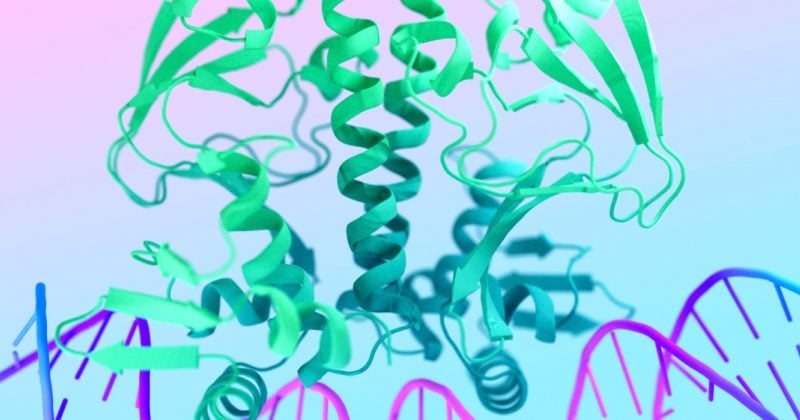
ContactSeek uses AlphaFold3 to predict contact probabilities between the editor protein and the DNA it’s handling, identifying which parts of the protein are touching the DNA most aggressively, then identifies specific amino acid residues that can be swapped out to make the tool more discerning about what it grabs onto.

The researchers focused primarily on adenine base editors built from the Cas9-TadA system. Their best-engineered variant incorporated just two mutations, one affecting the Cas9 domain and one affecting TadA8e, yet it vastly outperformed several established high-fidelity editors in both precision and activity.

The method also proved to be modular. The team successfully adapted ContactSeek for LbCas12a-based cytosine base editors, a different class of editing tool entirely. All data and code for ContactSeek v1.0.0 have been made publicly available on Zenodo and GitHub.

Why this matters beyond the lab bench

Gene therapy is no longer a speculative technology. The first CRISPR-based therapies have already reached patients. But off-target effects remain the single biggest regulatory and safety concern holding back broader approval of these treatments.

A framework that can systematically improve the precision of editing tools, using AI predictions rather than years of trial-and-error mutagenesis, compresses the development timeline significantly.

Disclosure: This article was edited by Editorial Team. For more information on how we create and review content, see our Editorial Policy.

AlphaFold AI redesigns gene-editing proteins to enhance safety, and biotech investors should pay attention

AlphaFold AI redesigns gene-editing proteins to enhance safety, and biotech investors should pay attention

A new AI framework called ContactSeek uses AlphaFold3 to engineer safer gene-editing tools, with implications that stretch far beyond the lab

Google DeepMind’s AlphaFold has already won a Nobel Prize for cracking the protein-folding problem. Now researchers are using its successor, AlphaFold3, to solve one of gene therapy’s most persistent headaches: the tendency of gene-editing tools to accidentally cut the wrong DNA.

A study published on July 22, 2026, in Nature introduces ContactSeek, a framework that leverages AlphaFold3’s structural predictions to redesign base editors, the molecular scissors used to make precise changes to individual DNA letters. The result is gene-editing proteins that are dramatically more accurate than existing high-fidelity alternatives, while still getting the job done on the sequences they’re supposed to edit.

Advertisement

How ContactSeek actually works

ContactSeek uses AlphaFold3 to predict contact probabilities between the editor protein and the DNA it’s handling, identifying which parts of the protein are touching the DNA most aggressively, then identifies specific amino acid residues that can be swapped out to make the tool more discerning about what it grabs onto.

The researchers focused primarily on adenine base editors built from the Cas9-TadA system. Their best-engineered variant incorporated just two mutations, one affecting the Cas9 domain and one affecting TadA8e, yet it vastly outperformed several established high-fidelity editors in both precision and activity.

The method also proved to be modular. The team successfully adapted ContactSeek for LbCas12a-based cytosine base editors, a different class of editing tool entirely. All data and code for ContactSeek v1.0.0 have been made publicly available on Zenodo and GitHub.

Why this matters beyond the lab bench

Gene therapy is no longer a speculative technology. The first CRISPR-based therapies have already reached patients. But off-target effects remain the single biggest regulatory and safety concern holding back broader approval of these treatments.

A framework that can systematically improve the precision of editing tools, using AI predictions rather than years of trial-and-error mutagenesis, compresses the development timeline significantly.

Disclosure: This article was edited by Editorial Team. For more information on how we create and review content, see our Editorial Policy.