
Amazon and QuEra promise useful quantum error correction by 2028, and crypto should pay attention
The Libra quantum computer targets over 256 logical qubits and a million reliable operations, a milestone that could eventually reshape cryptographic security.
AWS and QuEra Computing just put a date on one of quantum computing’s biggest promises. The two companies announced an expanded collaboration to launch QuEra’s first fault-tolerant quantum computer, called Libra, on the Amazon Braket platform by 2028.
The system is designed to exceed 256 error-corrected logical qubits with a logical error rate of 10⁻⁶. In English: roughly one million reliable quantum operations running across hundreds of qubits, a threshold the industry calls “Megaquop-scale” performance. That’s a significant leap from the noisy, error-prone machines currently available.
What Libra actually is
Logical qubits are built from clusters of physical qubits working together to catch and correct mistakes. A machine with 256 logical qubits operating at one-in-a-million error rates would be a fundamentally different tool than anything that exists today. Current systems, including QuEra’s own Aquila processor already available on Amazon Braket, offer up to 256 physical qubits in analog mode.
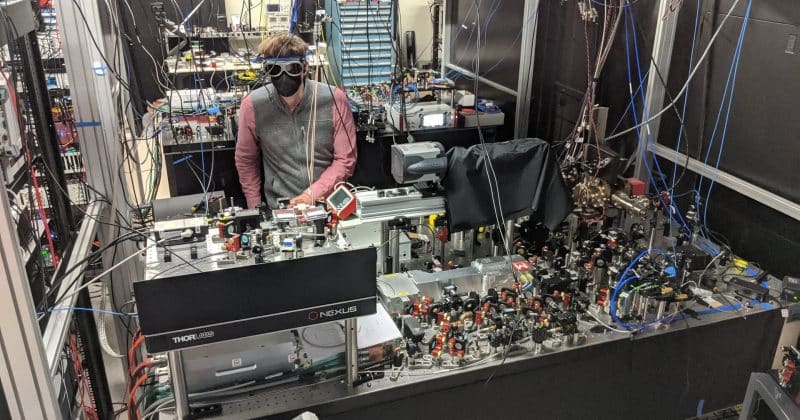
QuEra uses neutral-atom architecture, which traps individual atoms with laser beams to perform computations. This approach competes with superconducting systems (favored by Google and IBM) and trapped-ion processors (the specialty of companies like IonQ and Quantinuum). The neutral-atom method has shown particular promise for scaling up qubit counts while maintaining the connectivity needed for error correction.
QuEra’s roadmap is built on peer-reviewed research from 2024 and 2025, conducted alongside Harvard and MIT, demonstrating key advances in quantum error correction techniques. The partnership with AWS has been active since Amazon Braket launched in 2020, giving both sides years of integration work to build on.
AI, tech, and the markets they move—in one daily briefing.
Daily. Free. Join 34,000+ readers across crypto, finance, and policy.
Why 2028 is an aggressive but credible timeline
The goal is to enable early scientific applications that surpass what current noisy intermediate-scale quantum (NISQ) systems and classical computers can do. AWS plans to integrate Libra with its high-performance computing, AI, and machine learning infrastructure, creating hybrid quantum-classical workflows.
What this means for crypto and digital asset security
The cryptographic algorithms securing most digital assets today, including the elliptic curve cryptography underpinning Bitcoin and Ethereum, were designed for a world without fault-tolerant quantum computers. The estimates for breaking 256-bit elliptic curve cryptography generally require thousands of logical qubits, not hundreds.
The National Institute of Standards and Technology (NIST) has already begun standardizing post-quantum cryptographic algorithms, and blockchain projects are starting to explore quantum-resistant signature schemes. Ethereum researchers have discussed migration paths to post-quantum cryptography, though no concrete timeline exists for implementation.