Skip to content
Advertisement
Boeing secures 200 aircraft order from China, with potential to expand to 750 planes

Boeing secures 200 aircraft order from China, with potential to expand to 750 planes

China's Commerce Ministry confirmed the deal on May 20, marking Boeing's first major sale to the country in nearly a decade.

GE Aerospace (GE) price

Full chart and stats

Loading chart…

Market cap
$323.5B (shares as of 2026-09-30)
P/E (trailing)
36.1 (EPS to 2026-09-30)
Annual revenue
$45.9B USD (FY ended 2025-12-31) 10-K
Annual revenue growth
+18.5% (FY ended 2025-12-31 vs FY ended 2024-12-31) 10-K
Annual net income
8,704,000,000 USD (FY ended 2025-12-31, attributable to the company) 10-K
Annual operating margin
Unavailable
Forward P/E
Unavailable: no dated forecast source

Gloria daily close for session Oct 29, 2026. Market cap and trailing P/E use this close with the SEC share total and trailing diluted earnings, each dated next to its figure. Annual revenue, revenue growth, net income and margin show their own fiscal period and link the 10-K. Current context may postdate this article.

GE Aerospace and its peers

Company PriceMarket capP/E (trailing)Forward P/EAnnual revenue (USD)Annual revenue growthAnnual net income (USD)Operating margin
GE Aerospace GE · Price dated Oct 29, 2026 $313$323.5B36.1Unavailable$45.9BFY ended 2025-12-31 · 10-K+18.5%FY ended 2025-12-31 vs 2024-12-31 · 10-K8,704,000,000FY ended 2025-12-31, attributable to the company · 10-KUnavailable
GE Vernova Inc. GEV · Price dated Oct 29, 2026 $888$235.0B23.3Unavailable$38.1BFY ended 2025-12-31 · 10-K+9.0%FY ended 2025-12-31 vs 2024-12-31 · 10-K4,884,000,000FY ended 2025-12-31, attributable to the company · 10-K3.6%FY ended 2025-12-31
Applied Materials Inc. AMAT · Price dated Oct 29, 2026 $422$334.6B36.4Unavailable$28.4BFY ended 2025-10-26 · 10-K+4.4%FY ended 2025-10-26 vs 2024-10-27 · 10-K6,998,000,000FY ended 2025-10-26, attributable to the company · 10-K29.2%FY ended 2025-10-26
Texas Instruments Incorporated TXN · Price dated Oct 29, 2026 $313$286.0B40.6Unavailable$17.7BFY ended 2025-12-31 · 10-K+13.0%FY ended 2025-12-31 vs 2024-12-31 · 10-K5,001,000,000FY ended 2025-12-31, attributable to the company · 10-K34.1%FY ended 2025-12-31

Missing figures stay unavailable. Forward P/E requires a dated source. Annual revenue, revenue growth, net income and margin come from each company's own 10-K, in US dollars, and each row shows that fiscal year. Revenue growth compares the fiscal year with the prior year stated in the same 10-K. Net income is the full year amount attributable to the company, or available to common stockholders where the filing states only that, or consolidated net income. Each row names its basis. Trailing P/E reads "Not meaningful" when the dated trailing diluted EPS is a loss or zero. An operating margin appears only when the filing states both the operating income and the revenue for the same year.

Sources: SEC filings and Gloria daily closes. Oldest record refresh: Oct 29, 2026, 1:17 PM EDT. Refresh is not a price or filing date. Each row shows its price date and its annual fiscal period. Peers use industry code and company size, or editorial selection. Market cap multiplies that row price by the company share total the latest SEC filing states for every share class together. Trailing P/E divides it by trailing diluted earnings from SEC filings. Rolled earnings per share are approximate because share counts can change between periods. Both appear only when the SEC data carries its date, so they are estimates at one price date, not synchronized filing valuations. Not investment advice.

Boeing just landed its biggest Chinese deal in years. China confirmed a purchase of roughly 200 commercial aircraft, with the potential to scale up to 750 planes if performance benchmarks are met.

The initial order, which includes engines from GE Aerospace along with spare parts and related equipment, represents a meaningful reopening of a market that had been effectively frozen for Boeing since 2017.

How the deal came together

President Donald Trump first announced the accord on May 15 during a summit with Chinese President Xi Jinping in Beijing. Boeing confirmed its commitment to the initial 200-aircraft order shortly after.

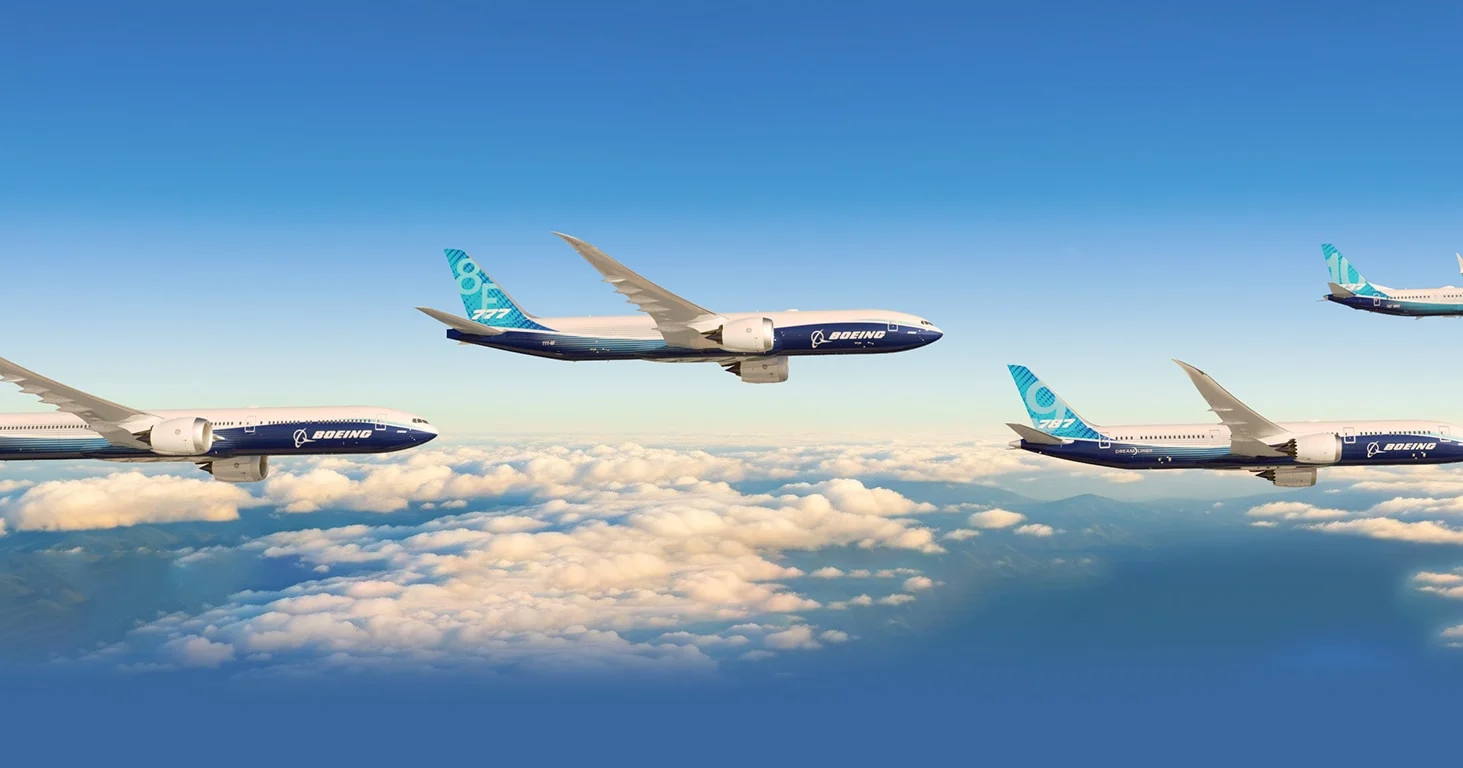
China’s Commerce Ministry then formally solidified the purchase on May 20, putting an official government stamp on what had been a diplomatic announcement. The fleet is expected to consist predominantly of 737 and 777 models, two of Boeing’s most commercially significant product lines.

Advertisement

The initial 200 planes are locked in, and the remaining 550 function more like an option than a guarantee, contingent on Boeing meeting unspecified performance standards.

The inclusion of GE Aerospace engines integrates another major American industrial player into the supply chain. Engine deals come with decades of maintenance contracts, spare parts revenue, and aftermarket servicing.

Nearly a decade of frozen skies

Boeing’s presence in China had been declining since roughly 2017, caught in the crossfire of escalating trade tensions between Washington and Beijing.

There was also the matter of China’s own ambitions. The country has been developing the COMAC C919, a domestically produced narrow-body jet designed to compete directly with the Boeing 737 and Airbus A320. Early deliveries of the C919 began in recent years, signaling that Beijing was at least partially serious about reducing dependence on Western manufacturers.

What this means for investors

Boeing’s commercial airplane division generates the bulk of its revenue, and an order of this size provides visibility into production schedules and cash flows. For suppliers, subcontractors, and the broader aerospace manufacturing ecosystem, confirmed orders translate directly into hiring plans, capital expenditure decisions, and margin forecasts.

GE Aerospace stands to benefit in parallel. Engine orders tied to 200 aircraft already represent meaningful revenue, and the aftermarket servicing contracts that follow could generate income for decades.

Airbus has spent years building market share in China while Boeing was sidelined. And COMAC’s C919 adds a wildcard that didn’t exist a decade ago, meaning Boeing isn’t just competing with Airbus for Chinese orders anymore; it’s competing with China’s own national champion.
Disclosure: This article was edited by Editorial Team. For more information on how we create and review content, see our Editorial Policy.

More in Business

See all
Previous storySamsung Electronics averts strike with pay deal, divisions emerge among workers