
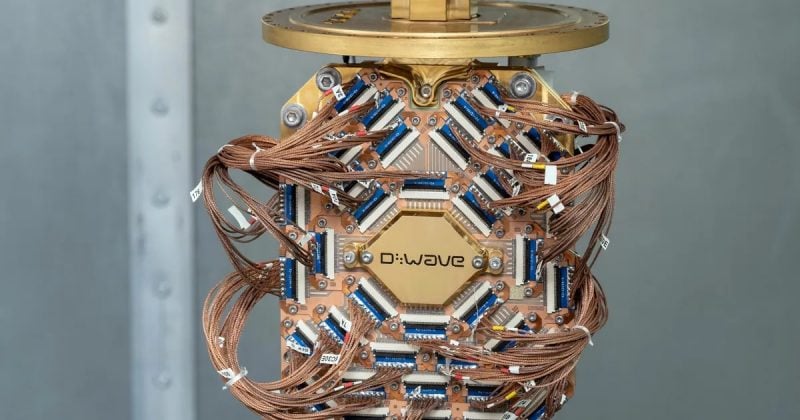
D-Wave tests entanglement on dual-rail qubits in new research, and crypto should be paying attention

Via spectrum.ieee.org

D-Wave tests entanglement on dual-rail qubits in new research, and crypto should be paying attention

The quantum annealing pioneer just demonstrated logical multi-qubit entanglement with fidelities that inch closer to the fault-tolerant threshold cryptography has been nervously watching.

D-Wave Quantum, the company that has spent two decades being the quantum computing industry’s quirky uncle, just posted research results that deserve more than a passing glance from the crypto world. The company demonstrated logical multi-qubit entanglement using dual-rail superconducting qubits, achieving a logical Bell state fidelity of 98.8% and a three-logical-qubit GHZ state at 93.5% fidelity.

What D-Wave actually built

The results come from an April 2025 preprint published on arXiv, leveraging technology D-Wave acquired when it bought Yale spinout Quantum Circuits Inc. (QCI) on January 20, 2026, for $550 million. That deal, structured as $300 million in stock and $250 million in cash, gave D-Wave access to QCI’s dual-rail qubit architecture.

Dual-rail qubits can flag roughly 90% of their own errors at the single-qubit level. D-Wave reported 99.9% two-qubit fidelity using this architecture. The team also executed a logical CNOT gate with a process fidelity of 96.2%.

Advertisement

D-Wave’s roadmap calls for its first dual-rail gate-model system in 2026, with plans to reach 100 logical qubits capable of executing over 1 million operations by 2032.

Why crypto can’t afford to ignore this

D-Wave’s results don’t mean anyone is cracking Bitcoin wallets tomorrow. The company went from being a niche quantum annealing shop, building machines that couldn’t run the algorithms needed to attack cryptographic systems, to demonstrating high-fidelity logical operations on gate-based hardware. That’s the type of hardware that, at sufficient scale, could run Shor’s algorithm and factor the large prime numbers protecting public-key cryptography.

The 100-logical-qubit target by 2032 is still far below the estimated thousands of logical qubits needed to break RSA-2048 or ECDSA, the signature scheme securing Bitcoin transactions. This is precisely why NIST finalized its post-quantum cryptographic standards in 2024.

The market angle and what to watch

D-Wave trades on the NYSE under the ticker QBTS. It has no associated crypto-native token. The $550 million QCI acquisition was a significant bet for D-Wave. Successful execution on the dual-rail roadmap could validate that investment.

The key metric to track is not just qubit count but logical qubit count with sufficient fidelity. D-Wave hitting 98.8% on Bell states is impressive. Getting that number consistently above 99.5% across larger systems would be a genuine inflection point. The gap between 98.8% and 99.9% sounds small. In quantum error correction, it’s the difference between a science project and a weapon.

Disclosure: This article was edited by Editorial Team. For more information on how we create and review content, see our Editorial Policy.

D-Wave tests entanglement on dual-rail qubits in new research, and crypto should be paying attention

D-Wave tests entanglement on dual-rail qubits in new research, and crypto should be paying attention

The quantum annealing pioneer just demonstrated logical multi-qubit entanglement with fidelities that inch closer to the fault-tolerant threshold cryptography has been nervously watching.

Via spectrum.ieee.org

D-Wave Quantum, the company that has spent two decades being the quantum computing industry’s quirky uncle, just posted research results that deserve more than a passing glance from the crypto world. The company demonstrated logical multi-qubit entanglement using dual-rail superconducting qubits, achieving a logical Bell state fidelity of 98.8% and a three-logical-qubit GHZ state at 93.5% fidelity.

What D-Wave actually built

The results come from an April 2025 preprint published on arXiv, leveraging technology D-Wave acquired when it bought Yale spinout Quantum Circuits Inc. (QCI) on January 20, 2026, for $550 million. That deal, structured as $300 million in stock and $250 million in cash, gave D-Wave access to QCI’s dual-rail qubit architecture.

Dual-rail qubits can flag roughly 90% of their own errors at the single-qubit level. D-Wave reported 99.9% two-qubit fidelity using this architecture. The team also executed a logical CNOT gate with a process fidelity of 96.2%.

Advertisement

D-Wave’s roadmap calls for its first dual-rail gate-model system in 2026, with plans to reach 100 logical qubits capable of executing over 1 million operations by 2032.

Why crypto can’t afford to ignore this

D-Wave’s results don’t mean anyone is cracking Bitcoin wallets tomorrow. The company went from being a niche quantum annealing shop, building machines that couldn’t run the algorithms needed to attack cryptographic systems, to demonstrating high-fidelity logical operations on gate-based hardware. That’s the type of hardware that, at sufficient scale, could run Shor’s algorithm and factor the large prime numbers protecting public-key cryptography.

The 100-logical-qubit target by 2032 is still far below the estimated thousands of logical qubits needed to break RSA-2048 or ECDSA, the signature scheme securing Bitcoin transactions. This is precisely why NIST finalized its post-quantum cryptographic standards in 2024.

The market angle and what to watch

D-Wave trades on the NYSE under the ticker QBTS. It has no associated crypto-native token. The $550 million QCI acquisition was a significant bet for D-Wave. Successful execution on the dual-rail roadmap could validate that investment.

The key metric to track is not just qubit count but logical qubit count with sufficient fidelity. D-Wave hitting 98.8% on Bell states is impressive. Getting that number consistently above 99.5% across larger systems would be a genuine inflection point. The gap between 98.8% and 99.9% sounds small. In quantum error correction, it’s the difference between a science project and a weapon.

Disclosure: This article was edited by Editorial Team. For more information on how we create and review content, see our Editorial Policy.