The British fintech swapped commercial coding assistants for open-weight models from Z.ai running on its own Nvidia hardware
Revolut has found a way to give its engineers more AI while spending far less on it. The British fintech says it cut its AI coding inference costs by roughly 90 percent in less than a year.
The trick was not a better vendor contract. Revolut made self-hosted, open-weight models its default and moved away from leaning mainly on commercial services like Anthropic’s Claude.
From rationed tokens to an open tab
David Abitbol, ops and infrastructure lead at Revolut, walked through the numbers at the AI Engineer conference in New York last month. The company rolled AI coding tools out to roughly 2,000 engineers.
After that rollout, Revolut measured a 60 percent improvement in coding time and a 70 percent improvement in lead time. Lead time tracks how long work takes to move from start to delivery, so the gain shows up beyond the keyboard.
The models doing the heavy lifting come from Z.ai, a Chinese AI lab. Revolut began deploying Z.ai’s GLM-5.1 model in April 2026 and later moved on to GLM-5.3.
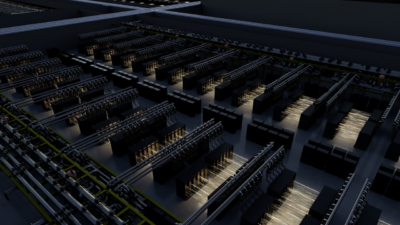
That newer model now runs on 56 Nvidia B200 GPUs inside Revolut’s own setup. The blended cost works out to approximately $0.30 per million tokens.
Before the switch, Revolut’s engineers used Anthropic’s Claude Code and OpenAI’s Codex. Usage on those commercial APIs produced bills of $1,000 to $10,000 monthly, which pushed the company into strict budget controls.
Those controls included token rationing. Engineers had to think twice before pointing AI at a task, which is a strange constraint to place on a tool meant to save time.
Speed, throughput and the boring work
Self-hosting let Revolut drop the rationing entirely. With access no longer metered, engineers can hand off the tedious surrounding chores, such as writing documentation and filing Jira tickets.
Revolut also tuned the system after launch. Optimizations carried out from April to August 2026 pushed throughput past 7 requests per second, a 76% increase.
Time-to-first-token, the pause between hitting enter and seeing the model start responding, fell by about 88%. It now averages 1.6 to 1.68 seconds.
The productivity bar Revolut cleared was also notable. Earlier models, including Gemini, delivered only 10-20% productivity gains, which helped prompt the move toward self-hosting.
Why a bank running Chinese models on its own GPUs is a big deal
Revolut is a regulated financial company. The compliance setup includes running the AI weights on US infrastructure and keeping humans in the loop. In practice, that means the model’s code suggestions still get reviewed, and the model itself lives somewhere the company controls.
That distinction is worth spelling out. With an open-weight model, a company downloads the trained model and runs it on hardware it manages, so proprietary code does not have to leave its environment.
Self-hosting requires upfront hardware, infrastructure talent and months of tuning, as Revolut’s April to August optimization work shows. The economics of self-hosting improve with scale, and roughly 2,000 engineers is a lot of scale.
For now, Revolut has offered a concrete benchmark: about $0.30 per million tokens, double-digit gains in coding and delivery speed, and engineers who no longer have to ration their AI.