
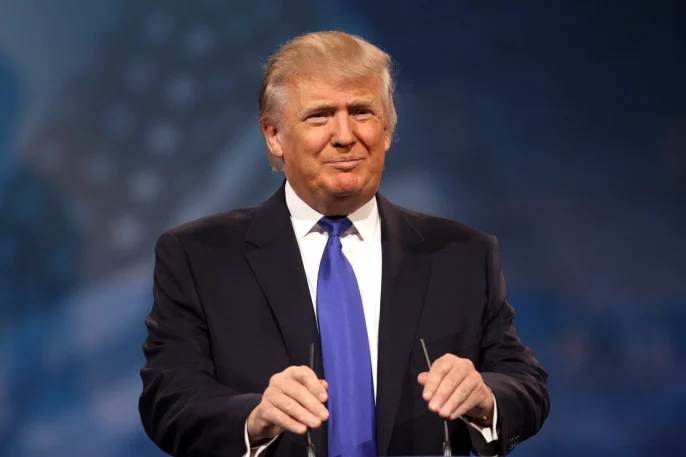
Gage Skidmore from Peoria, AZ, United States of America
Trump reaffirms support for data centers after AI executives meeting
Top tech CEOs sign voluntary 'Accord on Super Intelligence' at White House luncheon as president pushes industry self-regulation over government mandates
President Donald Trump hosted the CEOs of America’s biggest AI companies for a White House luncheon on September 29, where attendees signed what the administration is calling the “Accord on Super Intelligence.” The voluntary agreement commits tech firms to self-regulate their AI development processes, including both internal and external reviews, while Trump used the occasion to double down on his support for data center expansion across the country.
The guest list read like a Fortune 10 reunion: Elon Musk, Sundar Pichai, Jeff Bezos, and leaders from OpenAI and Microsoft all pulled up chairs. What they left with was a handshake deal that Trump described as “morally binding.”
The deal, and what it actually says
The Accord on Super Intelligence centers on voluntary commitments from AI companies to conduct rigorous reviews of their development pipelines, including both internal and external reviews.
Trump framed the agreement as a necessary alternative to heavy-handed government regulation. He warned that imposing excessive restrictions on AI companies could hamper American competitiveness, particularly against China, which has been pouring resources into its own AI capabilities.
Beyond the self-regulation framework, the president pressed executives on community relations. He called on AI companies to financially support local initiatives in areas where they build data centers and to take concrete steps to prevent their massive energy consumption from driving up electricity bills for nearby residents.
AI, tech, and the markets they move—in one daily briefing.
Daily. Free. Join 34,000+ readers across crypto, finance, and policy.
Data centers are projected to triple US energy demand by 2035.
Building on the Ratepayer Protection Pledge
The accord isn’t the first time Trump has corralled tech companies into making public promises about their energy footprint. Back in March 2026, Amazon, Google, Microsoft, and other major firms signed the “Ratepayer Protection Pledge,” committing to build or fund their own power generation rather than simply plugging into local grids and letting communities absorb the cost.
Trump also floated two ideas that caught attention beyond the policy substance. First, he mentioned the possibility of appointing an “AI czar” to coordinate the administration’s approach to the technology. Second, he proposed formally renaming artificial intelligence to “super intelligence.”
Why communities are pushing back
Data center projects that once sailed through local approval processes are now facing organized resistance. Energy consumption sits at the heart of the debate. A single large-scale data center can consume as much electricity as a small city, and the proliferation of AI workloads, which are far more power-intensive than traditional cloud computing, has accelerated the problem.
The bipartisan nature of the opposition makes it particularly tricky for the administration. Conservative landowners worried about property values and liberal environmentalists concerned about carbon emissions have found common cause in resisting unchecked data center growth.