
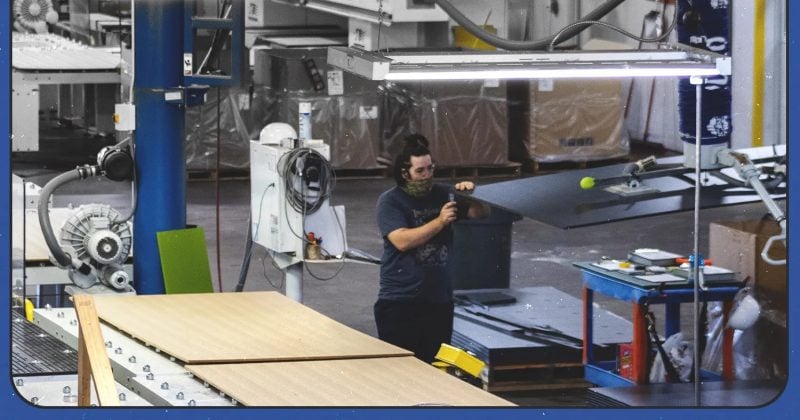
American manufacturers grow at fastest rate in 4 years amid AI boom

Via insidehook.com

American manufacturers grow at fastest rate in 4 years amid AI boom

The ISM manufacturing PMI hit 54.0 in May 2026, its highest reading since May 2022, but a looming labor shortage and supply-chain headaches could cap the rally.

US factories are humming again. The ISM Manufacturing PMI climbed to 54.0 in May 2026, a level the index hasn’t touched since May 2022, driven largely by an insatiable appetite for AI hardware, semiconductors, and the data centers that house them.

The S&P Global US Manufacturing PMI told a similar story, registering between 53.8 and 53.9 in July 2026 after more than a year of steady gains in new orders and production output.

What’s actually driving the rebound

Semiconductor fabrication plants, data center campuses, and factory construction have become the backbone of this manufacturing renaissance. Factory construction spending in the US more than doubled between 2021 and 2024, a surge that also attracted $2.42 trillion in foreign commitments over that period.

Advertisement

US manufacturing value added hit a record $2.91 trillion in 2024, establishing a new high-water mark before the AI-driven acceleration even fully kicked in.

The cracks in the foundation

Supplier delivery times worsened at one of the fastest rates in four years. Input-cost inflation remained elevated, though it did ease to a four-month low in July 2026.

A projected shortfall of 3.8 million skilled workers looms over the sector. Business confidence fell to its lowest level since October 2025, according to recent PMI surveys.

Why crypto investors should pay attention

Projects focused on decentralized AI compute, like Render, Akash, and others in the DePIN category, are essentially betting that the same demand pressures showing up in traditional manufacturing data will eventually create overflow opportunities for blockchain-based alternatives. When supplier delivery times worsen and traditional infrastructure gets bottlenecked, decentralized alternatives start looking less like science experiments and more like viable overflow valves.

The $2.42 trillion in foreign commitments flowing into US factory construction also signals something broader about capital flows. A strengthening industrial base tends to support the dollar, which historically creates headwinds for Bitcoin, but it also tends to coincide with risk-on sentiment in technology sectors, which has been correlated with crypto rallies in recent cycles.

A shortage of 3.8 million workers creates pricing pressure on labor that feeds into inflation expectations. If inflation stays stickier than the Fed wants, rate cuts get delayed, and that has direct consequences for how much leverage flows into speculative assets.

Disclosure: This article was edited by Editorial Team. For more information on how we create and review content, see our Editorial Policy.

American manufacturers grow at fastest rate in 4 years amid AI boom

American manufacturers grow at fastest rate in 4 years amid AI boom

The ISM manufacturing PMI hit 54.0 in May 2026, its highest reading since May 2022, but a looming labor shortage and supply-chain headaches could cap the rally.

Via insidehook.com

US factories are humming again. The ISM Manufacturing PMI climbed to 54.0 in May 2026, a level the index hasn’t touched since May 2022, driven largely by an insatiable appetite for AI hardware, semiconductors, and the data centers that house them.

The S&P Global US Manufacturing PMI told a similar story, registering between 53.8 and 53.9 in July 2026 after more than a year of steady gains in new orders and production output.

What’s actually driving the rebound

Semiconductor fabrication plants, data center campuses, and factory construction have become the backbone of this manufacturing renaissance. Factory construction spending in the US more than doubled between 2021 and 2024, a surge that also attracted $2.42 trillion in foreign commitments over that period.

Advertisement

US manufacturing value added hit a record $2.91 trillion in 2024, establishing a new high-water mark before the AI-driven acceleration even fully kicked in.

The cracks in the foundation

Supplier delivery times worsened at one of the fastest rates in four years. Input-cost inflation remained elevated, though it did ease to a four-month low in July 2026.

A projected shortfall of 3.8 million skilled workers looms over the sector. Business confidence fell to its lowest level since October 2025, according to recent PMI surveys.

Why crypto investors should pay attention

Projects focused on decentralized AI compute, like Render, Akash, and others in the DePIN category, are essentially betting that the same demand pressures showing up in traditional manufacturing data will eventually create overflow opportunities for blockchain-based alternatives. When supplier delivery times worsen and traditional infrastructure gets bottlenecked, decentralized alternatives start looking less like science experiments and more like viable overflow valves.

The $2.42 trillion in foreign commitments flowing into US factory construction also signals something broader about capital flows. A strengthening industrial base tends to support the dollar, which historically creates headwinds for Bitcoin, but it also tends to coincide with risk-on sentiment in technology sectors, which has been correlated with crypto rallies in recent cycles.

A shortage of 3.8 million workers creates pricing pressure on labor that feeds into inflation expectations. If inflation stays stickier than the Fed wants, rate cuts get delayed, and that has direct consequences for how much leverage flows into speculative assets.

Disclosure: This article was edited by Editorial Team. For more information on how we create and review content, see our Editorial Policy.