
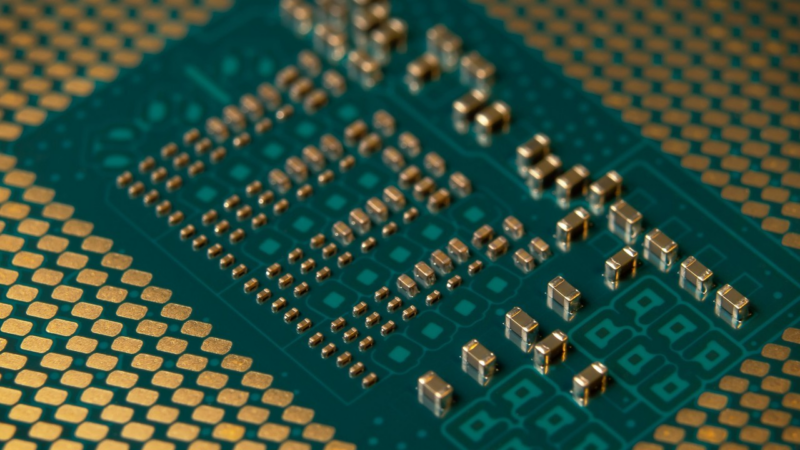
Photo: ed br / Pexels
Michael Burry backs Ken Griffin’s warning that GPU prices could crash
The Big Short investor says the risk of AI chip overcapacity is obvious, as semiconductor stocks post their worst week since April 2025
Two of Wall Street’s best-known skeptics are now reading from the same script on AI chips. Michael Burry has publicly sided with Citadel founder Ken Griffin, who warned that GPU prices could collapse once supply outpaces demand.
Burry skipped the diplomatic phrasing. On October 26, 2026, he said the risk is “obvious to most with a working brain cell.”
The dark fiber comparison
Griffin made his case at Citadel’s Future of Global Markets conference, held October 20-21, 2026. His main historical reference was the 2000 telecom fiber-optic bubble.
That bust left behind what the industry called “dark fiber,” meaning cable that was installed but never lit up with traffic. Griffin’s concern is that GPUs could follow a similar arc, with surplus capacity crushing prices.
He also compared GPU supply dynamics to the airline industry.
Griffin didn’t stop at pricing. He said investors are “almost certainly” in an AI bubble when it comes to GPU demand.
He also raised doubts about how long older GPU models stay useful. In a field where the technology moves this quickly, he questioned whether earlier chips remain economically viable for long.
And if supply does run ahead of demand, Griffin argued GPU pricing could slide into free fall.
AI, tech, and the markets they move—in one daily briefing.
Daily. Free. Join 34,000+ readers across crypto, finance, and policy.
Markets were already uneasy before Burry chimed in. The Philadelphia Semiconductor Index, better known as SOX, dropped 11.4% in a single week.
That was the index’s steepest weekly decline since April 2025. Analysts at BTIG expect the semiconductor slump could stretch into 2027.
Burry’s accounting problem with hyperscalers
Burry argues the largest hyperscalers appear to be extending depreciation schedules on their hardware. That would be happening even as the chips themselves face rapid technological obsolescence.
He has put a number on the gap. Burry estimates the understated depreciation expenses at approximately $176 billion for 2026-2028.
Burry has also repeatedly warned about potential circular financing arrangements tied to hyperscalers’ AI investments.
Griffin’s warning and Burry’s critique connect neatly. If older GPUs lose value faster than expected, longer depreciation schedules become harder to defend.
What it means for AI hardware investors
The pairing matters because it attacks the AI hardware trade from two directions at once. Griffin is questioning the price of the product, while Burry is questioning the quality of the earnings built on buying it.
Hyperscaler earnings reports and their depreciation disclosures are the obvious ones to watch, since that is where Burry’s estimate would either gain or lose credibility.
Capital expenditure guidance is another. Any sign that the biggest buyers are slowing their spending would strengthen Griffin’s overcapacity argument.
GPU pricing itself is the most direct signal. If older chips start trading at steep discounts, the dark fiber comparison stops being a conference talking point and becomes a market reality.