
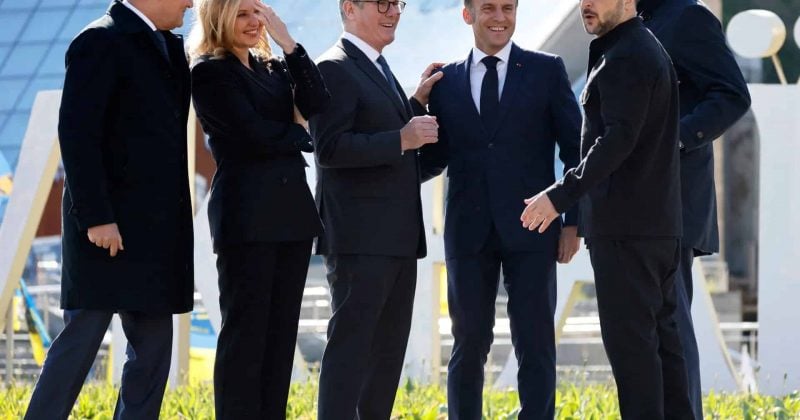
European leaders back Ukraine’s ceasefire call as Putin doubles down on military action
A united front from Europe's biggest powers meets familiar Russian resistance, while crypto markets register the geopolitical tremors in real time.
Leaders from the UK, France, Germany, and Poland traveled to Kyiv on May 10, 2025, in a coordinated show of solidarity. They arrived with a concrete proposal: an unconditional 30-day ceasefire beginning May 12. US President Trump backed the ceasefire call. If Russia ignored the demands, new sanctions targeting the country’s banking and energy sectors were on the table.
Putin rejected the European terms outright and countered with a proposal for direct negotiations in Istanbul, minus any preconditions. He also refused to commit to post-ceasefire security guarantees.
Ukrainian President Volodymyr Zelenskyy proposed an immediate frontline ceasefire as recently as June 4, 2026, along with a prisoner-of-war exchange and monitoring by the US. Putin’s rejection continued. The Russian president suggested former German Chancellor Gerhard Schröder as a potential mediator. Schröder has long been criticized for his close ties to Russian energy interests, including his role on the board of Russian state energy companies. European leaders dismissed the suggestion almost immediately.
Bitcoin reached upward of $80,000 during ceasefire discussions over the 2025-2026 period and experienced a 1.2% increase to $68,400 during shorter truce windows. The conflict has also triggered short-term liquidity spikes in both Bitcoin and Ethereum. Trading volumes increase as news breaks, with traders repositioning based on whether they think tensions are rising or falling. These liquidity surges tend to normalize within a few days.
The news moving money, markets, and the world—before your day starts.
Daily. Free. Join 34,000+ readers across crypto, finance, and policy.
Sanctions on Russia’s energy sector, if actually implemented, could ripple through global commodity markets. The banking sector restrictions, in particular, could affect how Russian entities interact with global financial rails. Some evidence supports the theory that this pushes volume toward decentralized alternatives, though the effect has been modest relative to the hype.