
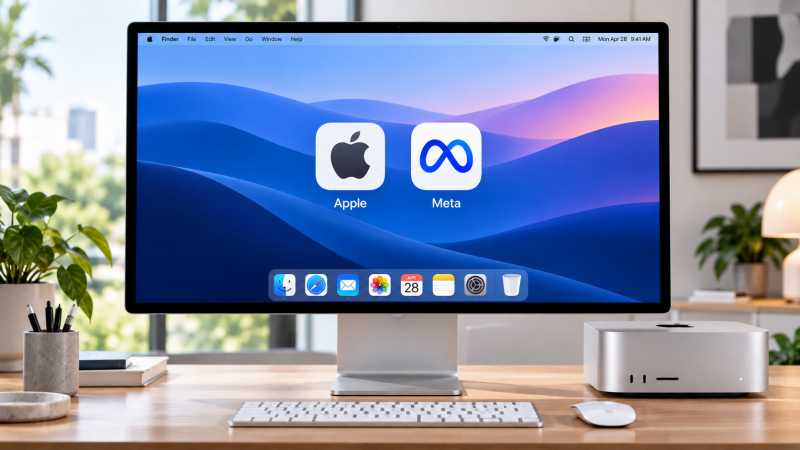
Meta partners with Apple to run 816B parameter Muse Spark Open locally on Macs
The longtime technology rivals collaborated to optimize Meta's new Muse Spark Open model for Apple's M5 Ultra Mac Studios, allowing developers to run advanced AI systems locally.
Apple and Meta have joined forces to bring a powerful open weight artificial intelligence model to Apple’s Mac computers, marking an unusual collaboration between two longtime Silicon Valley rivals.
Meta announced Thursday the release of Muse Spark Open, an AI model featuring 816 billion total parameters, with 42 billion activated during inference, and a context window of one million tokens.
The companies worked together to optimize the model for Apple’s M5 Ultra Mac Studios using the MLX framework. The system allows developers to run the model locally across two connected computers without relying on cloud infrastructure.
Meta describes Muse Spark Open as the most capable US developed open weight AI model to date, positioning it as an alternative to proprietary systems from leading AI companies.
Meta brings powerful AI models to Apple hardware
Muse Spark Open is designed for complex reasoning, software engineering and AI agent workflows that require multiple steps to complete.
The model uses a mixture of experts architecture, activating only a portion of its 816 billion parameters during inference to reduce computational requirements.
According to Meta, each M5 Ultra Mac Studio supports up to 512 GB of unified memory and delivers 1.2 TB/s of memory bandwidth.
Together, two machines provide approximately one terabyte of unified memory, enough to accommodate the entire model and run advanced AI workloads locally.
Meta demonstrated the technology through several practical applications, including using AI agents to develop new features and fix bugs in Ice Cubes, an open source Mastodon client.
The company also tested the model with DaVinci Resolve, allowing an AI agent to analyze footage frame by frame, identify relevant moments and create vertical video crops.
AI, tech, and the markets they move—in one daily briefing.
Daily. Free. Join 34,000+ readers across crypto, finance, and policy.
Unlike models available exclusively through cloud services, Muse Spark Open can be downloaded and operated on compatible hardware.
The model is also available through cloud providers and development platforms, including Google Cloud, Amazon SageMaker, Hugging Face, Microsoft Foundry and OpenRouter.
Meta is releasing the weights under its Muse Model License, which allows many developers to use the model for free under limited commercial terms.
Apple and Meta put years of rivalry aside amid AI competition
The collaboration marks a shift in the relationship between Apple and Meta, whose executives have repeatedly clashed over privacy, advertising and the future of computing.
In 2018, Apple CEO Tim Cook criticized Facebook’s handling of user privacy following the Cambridge Analytica scandal, prompting a public response from Meta CEO Mark Zuckerberg.
Their rivalry intensified in 2021 when Apple introduced privacy protections that restricted advertising tracking across iOS applications, affecting Meta’s advertising business.
However, the companies began working together on Muse Spark Open several months ago, according to Meta’s AI chief Alexandr Wang.
Daniel Gross, a former Apple executive who joined Meta, played an important role in bringing the companies together, Wang told Axios.
The partnership comes as competition in open weight AI accelerates, with companies increasingly releasing models that developers can download, customize and operate on their own hardware.
Earlier this week, Meta introduced Muse Wonder and Muse Wonder Full, two advanced AI models designed to compete with offerings from OpenAI and Anthropic.
Meanwhile, Nvidia, Reflection AI and Mistral have also introduced new open weight models, expanding the alternatives available to developers and businesses.
For Meta, the collaboration offers another way to distribute its AI technology, while Apple can demonstrate the capabilities of its most powerful computers.
The companies have not announced plans to integrate Muse Spark Open into Apple Intelligence. For now, their cooperation focuses on making Meta’s model available for local execution on Mac hardware.
The partnership highlights how growing demand for AI infrastructure is reshaping relationships across the technology industry, even among companies that continue to compete in other areas.